Alan Amron · Press-On Memo, 1973 ← stickynotesinventor.com

Who invented the sticky note?Read the papers.

I was 24 in 1973 when I invented the sticky note — a memo sheet with a repositionable, reusable adhesive on the back, so the note goes where the message belongs and comes away clean. I put it into commerce as Press-On Memo in 1974 and gave 3M samples that year. In 1980 3M released Post-it Notes without me. I sued in 1997. They settled within weeks. I thought I got what I wanted. I didn’t.

I have kept the original documents for more than fifty years. In 1973 I was not building a legal record. I was a young man trying to sell a product, so what survives is the paper a small business throws off: a chemist's letter, a printer's job, a post office receipt, a corporation, a mailing, an order book. That is what there is, and I have put all of it here.

Every document below was filed in federal court. They are published one at a time, in order, with what each one shows and what it does not.

Why I settled with 3M

Two things happened in that agreement. They are not the same thing. For twenty-six years I treated the settlement as confidential because I understood 3M’s assurances, including its written reference to the confidentiality commitment “from either side,” to mean the commitment was mutual. In January 2024 3M asserted against me that the clause imposed no obligation on 3M.

The record, in order

Jump to a document

The documents

Document 1

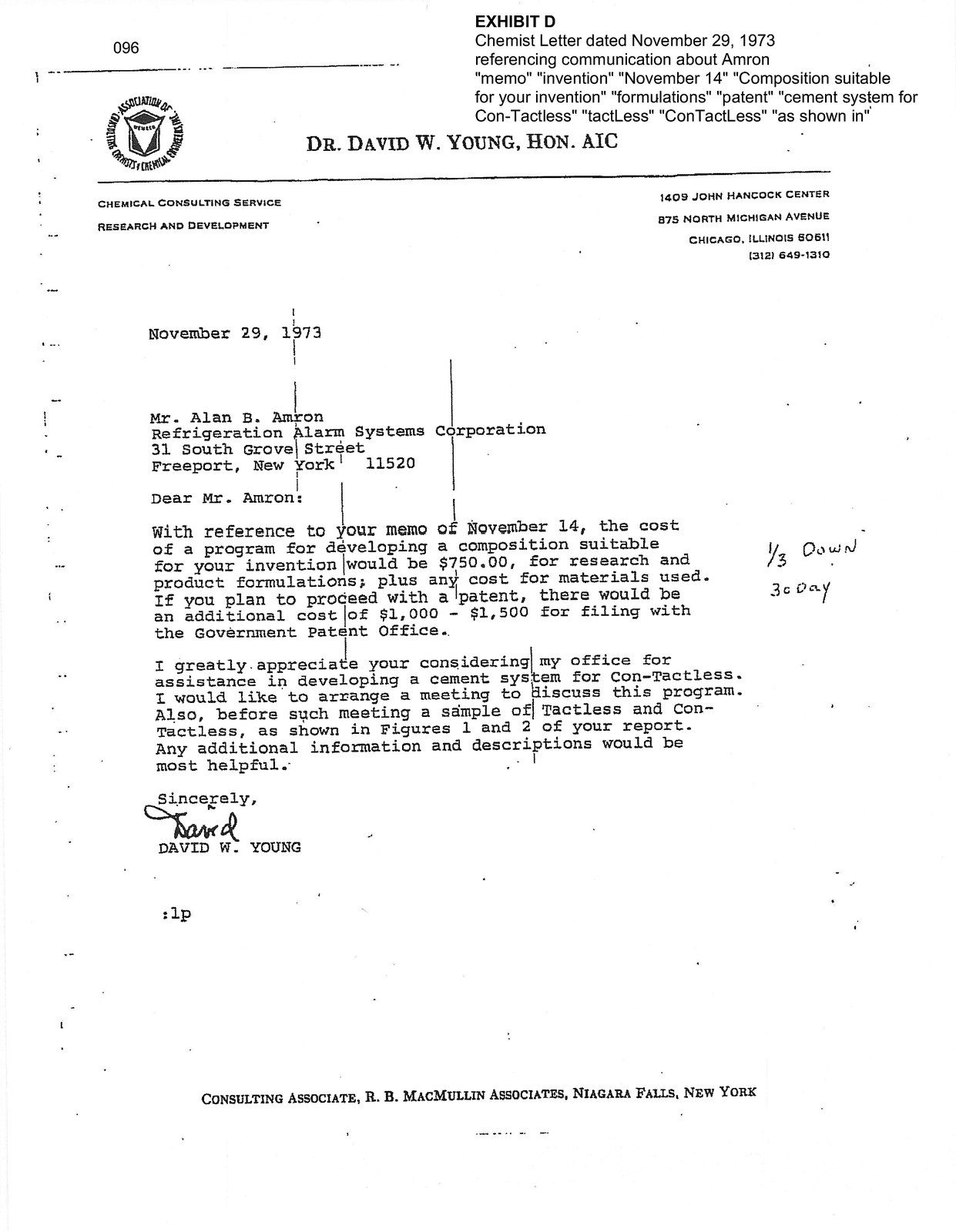
November 29, 1973

Dr. David W. Young, a chemical consultant working out of the John Hancock Center in Chicago, answers a memo I had sent him two weeks earlier. He quotes $750 to develop a composition suitable for my invention, plus the cost of filing with the patent office, and asks me to send the samples shown in Figures 1 and 2 of my report.

Figures 1 and 2. By the middle of November 1973 there was already a written report with numbered drawings, and a chemist in another state had quoted a fee to formulate an adhesive for it. This is the earliest paper in the story and the only one written by a stranger while the work was happening. Young was not remembering 1973 from 1997. He was in it, on the day, with a fee quote.

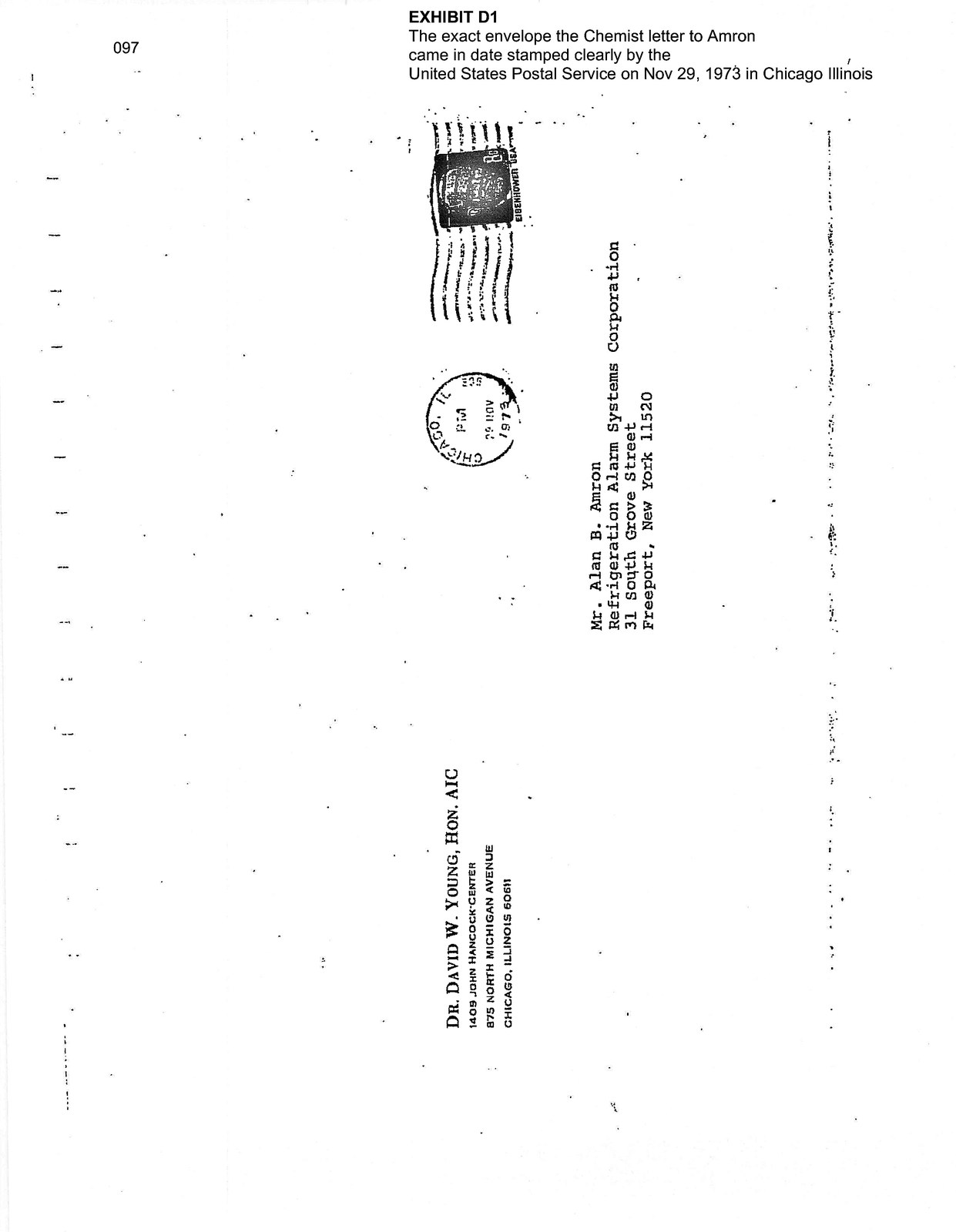
The letter is from a working chemist to a named client, on the record, about developing an adhesive for the memo project. The envelope carries a Chicago postmark of the same day.

Letter from Dr. David W. Young to Alan Amron, November 29, 1973
Exhibit D. Contrast adjusted for legibility; no content altered.
Envelope postmarked Chicago, November 29, 1973
Exhibit D1. The matching envelope, postmarked Chicago.
Document 2

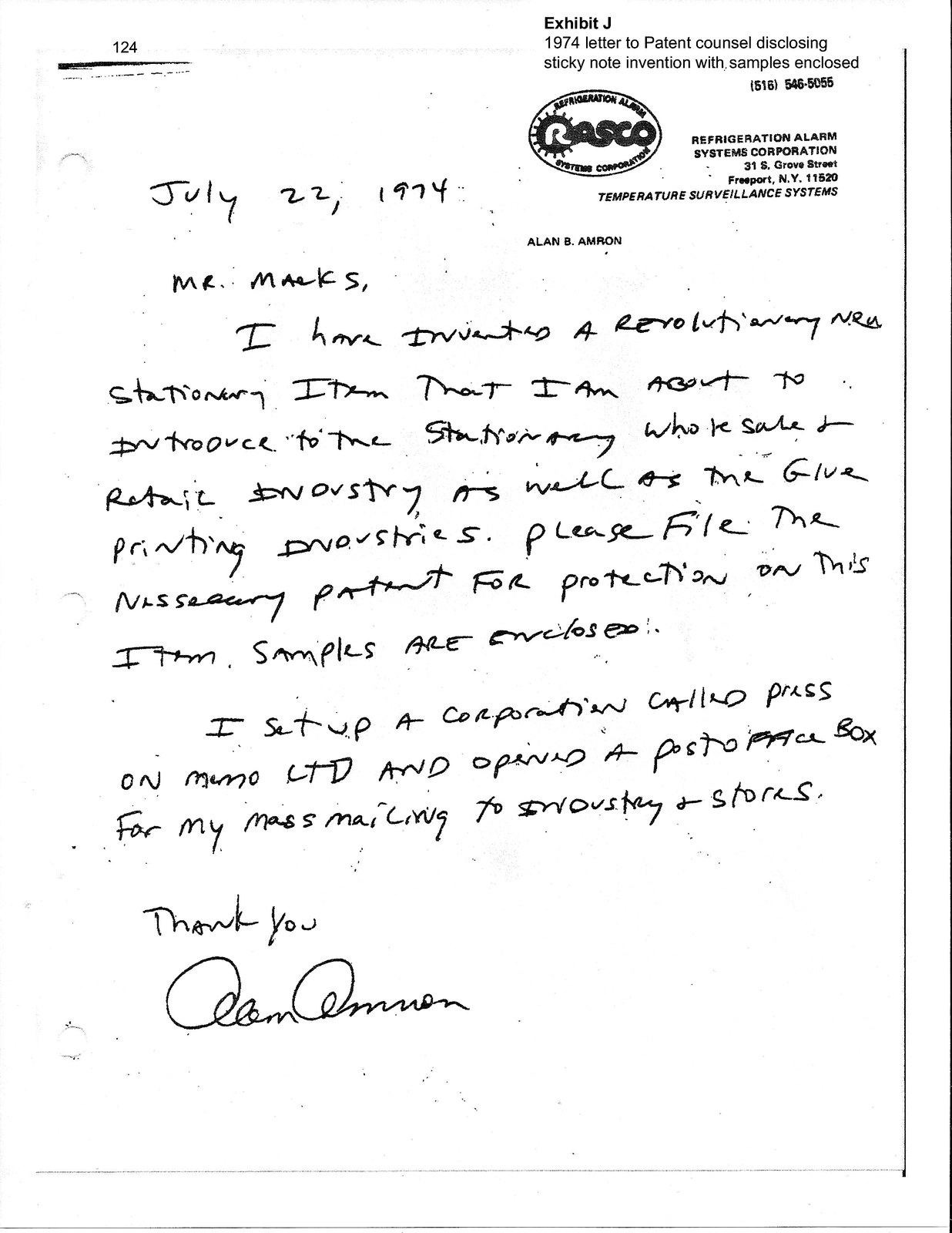
July 22, 1974 — Letter to patent counsel

In my own handwriting, to Charles Marks at 286 Fifth Avenue: "I have invented a revolutionary new stationery item that I am about to introduce to the stationery wholesale and retail industry, as well as the glue printing industries." I ask him to "file the necessary patent for protection on this item," and write, "Samples are enclosed."

In the same letter I record that I had set up a corporation called Press On Memo Ltd. and opened a post office box for my mass mailing to industry and stores.

One page, one date: the invention, the trade, the patent instruction, the samples, the company name, and the mailing.

Handwritten letter to patent counsel, July 22, 1974
Exhibit J.
Document 3

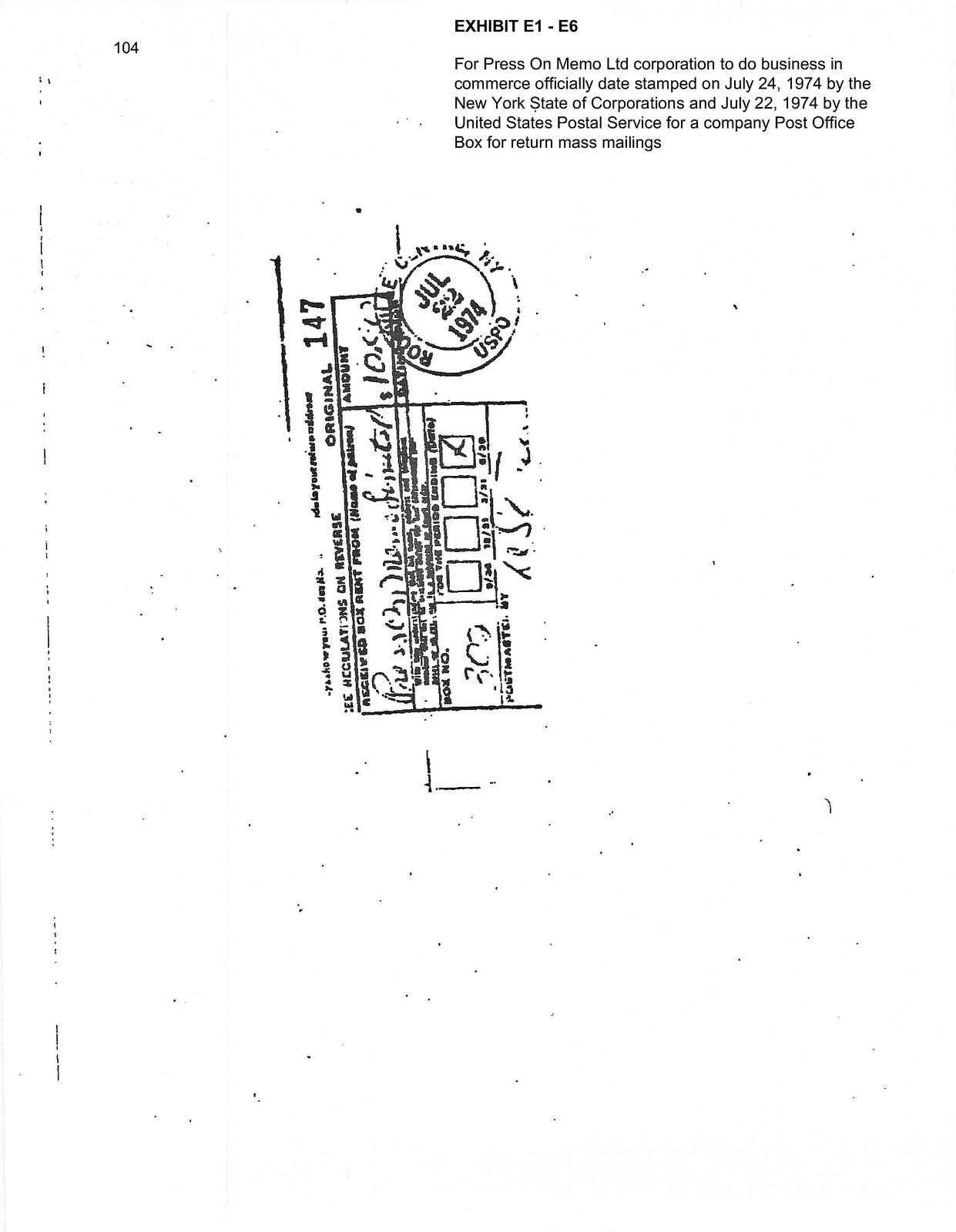
July 22, 1974 — Post Office receipt

The same day I wrote to my patent attorney, I opened the post office box. This is the original receipt for Box 302, Press On Memo Ltd., Rockville Centre, New York, marked ORIGINAL and carrying a round United States Post Office cancellation of that date.

Two documents, one day. One is mine. This one was stamped by the Post Office.

U.S. Post Office receipt for Box 302, July 22, 1974
Exhibit E6.
Document 4

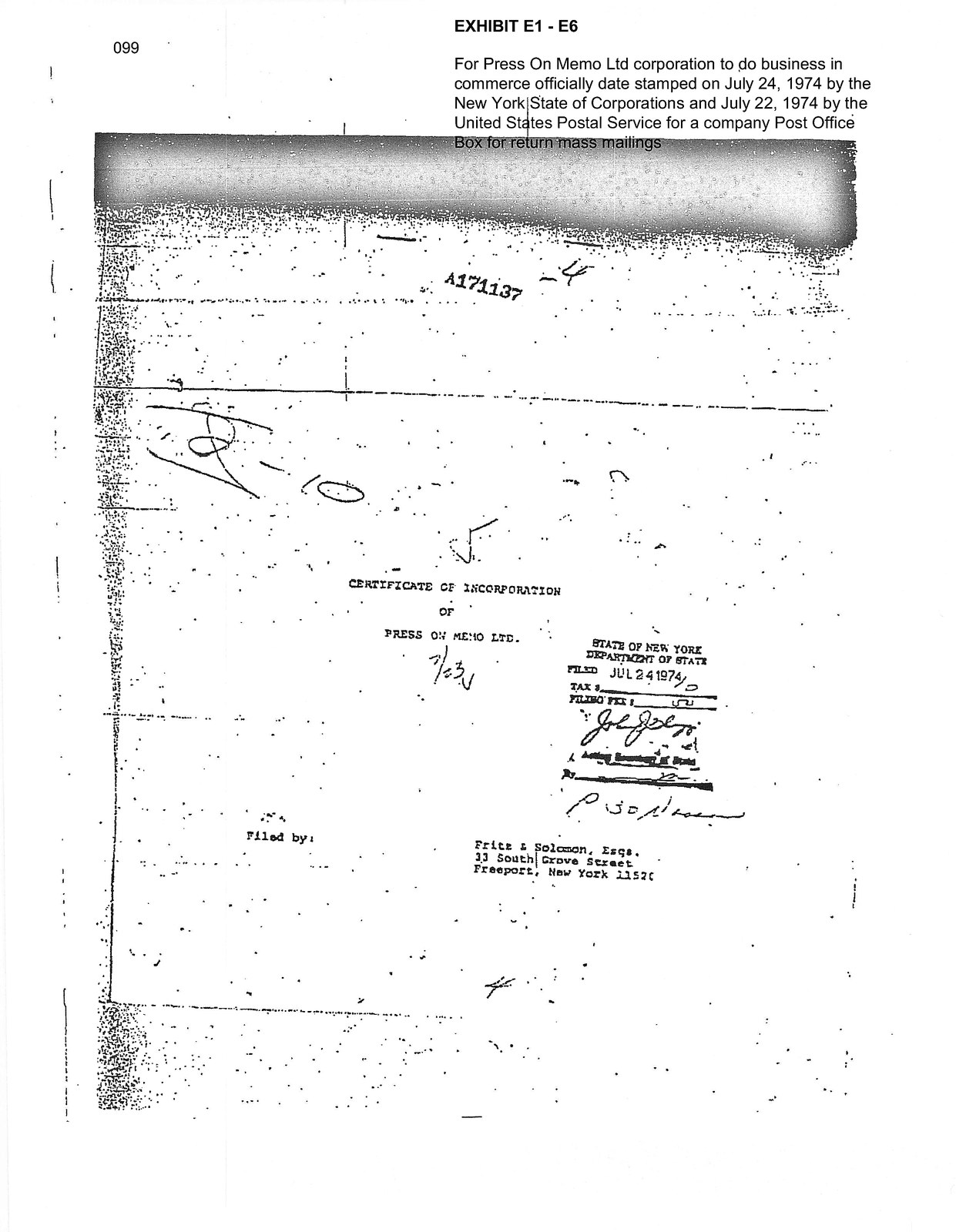
July 24, 1974 — Incorporation

Certificate of Incorporation of Press On Memo Ltd., filed under Section 402 of the New York Business Corporation Law. Department of State filing stamp dated July 24, 1974. Filing number A171137. Filed by Fritz & Solomon, Esqs., Freeport, New York.

The company was named for the product. This is the first page; the remainder follows it in the filed record.

New York Certificate of Incorporation, Press On Memo Ltd., July 24, 1974
Exhibit E1.
Document 5

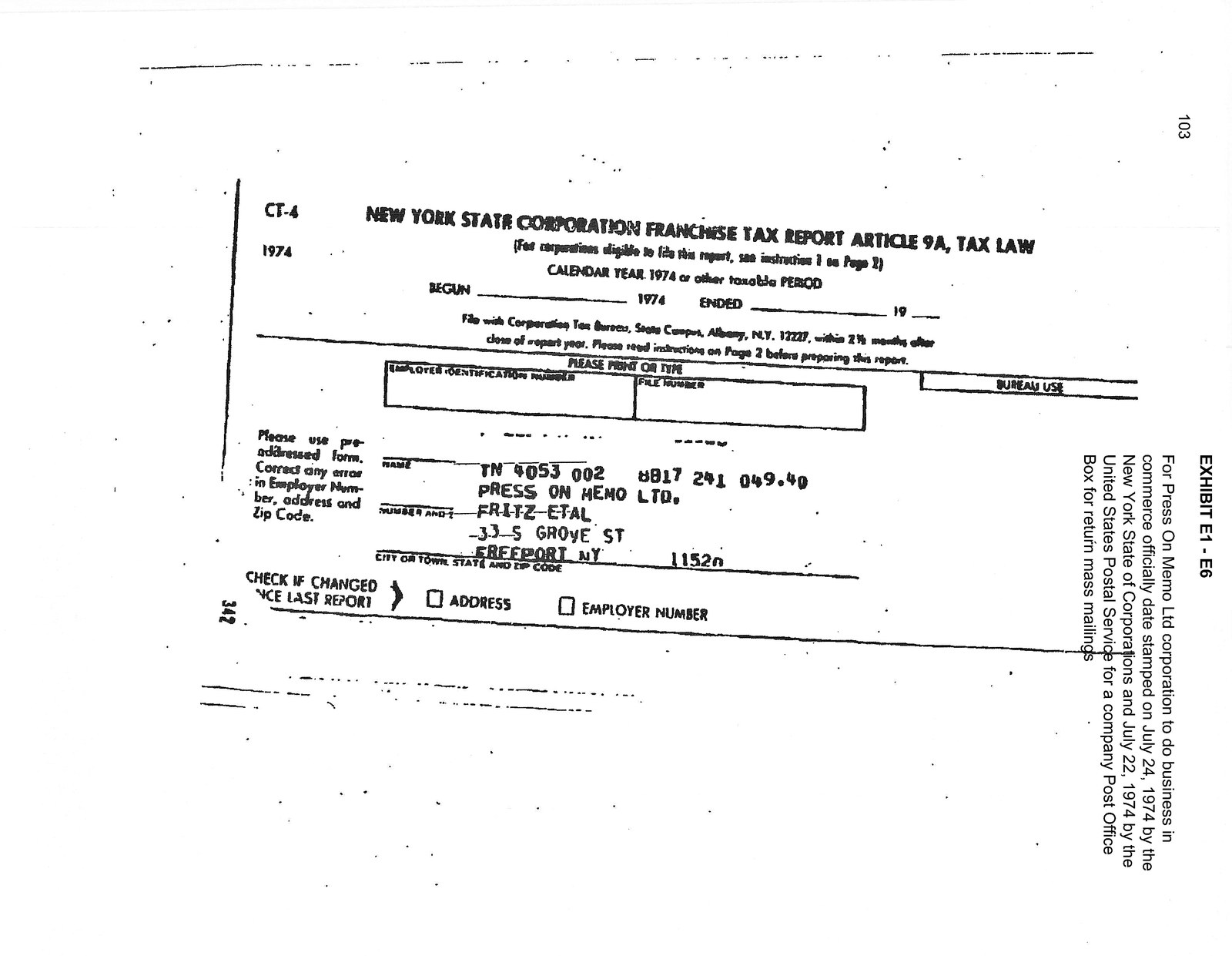
1974 — Franchise tax record

New York State Corporation Franchise Tax Report, Form CT-4, calendar year 1974, addressed to Press On Memo Ltd. at my attorneys' address in Freeport.

It is the dullest document on this page and that is exactly why it is here. A certificate of incorporation proves a filing fee was paid once. A franchise tax report is the state treating the company as a going concern with an obligation to it. Nobody invents a tax form.

A New York State corporation tax record for 1974 listing Press On Memo Ltd. The company was registered, filed and paying tax in its first year.

New York State Corporation Franchise Tax Report, Form CT-4, 1974
Exhibit E5. Rotated upright and contrast adjusted for legibility; no content altered.
Document 6

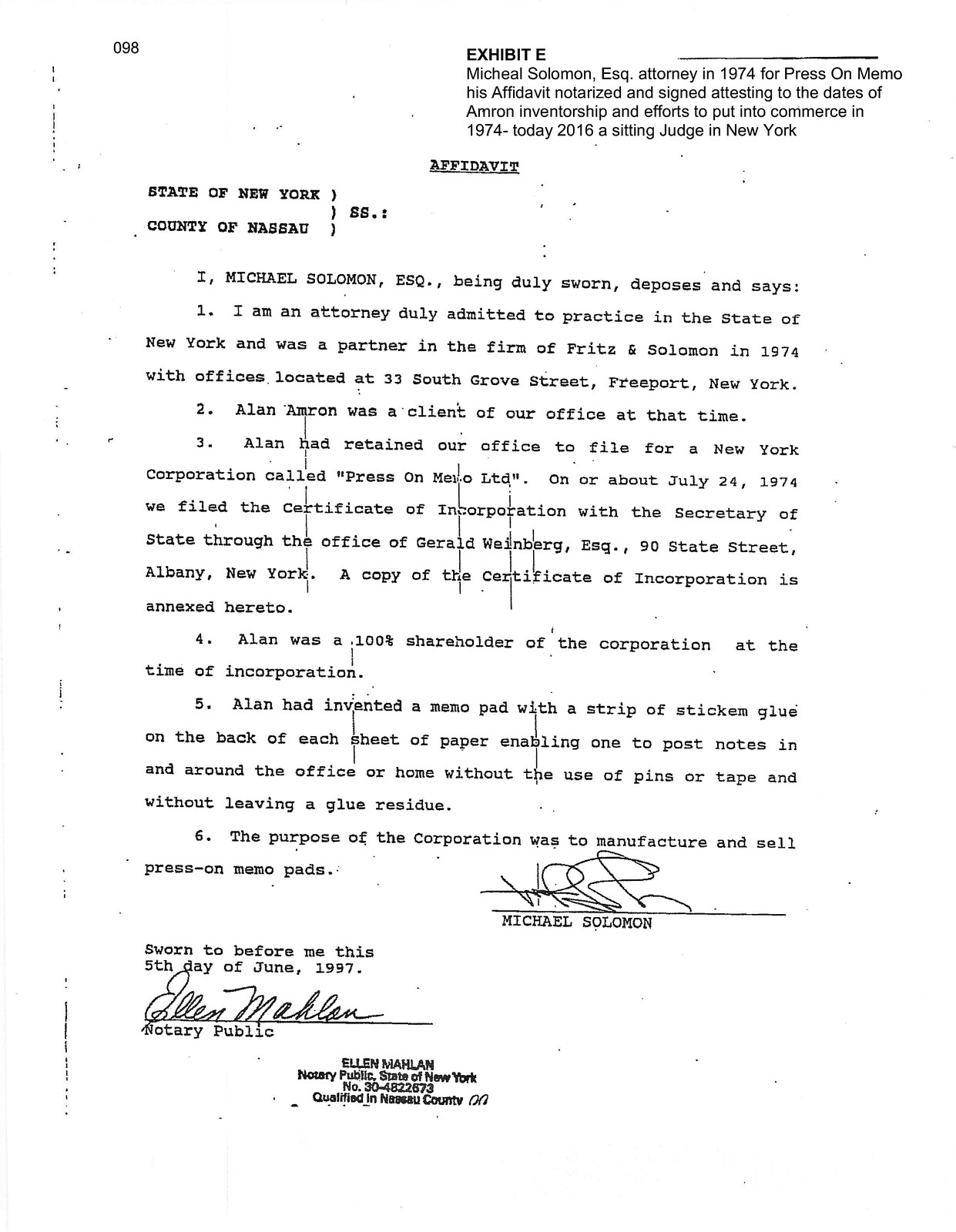
The affidavit of Michael Solomon

Michael Solomon was my attorney in 1974. He swore this affidavit on June 5, 1997. He states that he was a partner in Fritz & Solomon, that I was a client, that they filed the Certificate of Incorporation for Press On Memo Ltd. on or about July 24, 1974, and that I was the sole shareholder.

Then, in his words: that I had invented a memo pad with a strip of stickem glue on the back of each sheet of paper, enabling one to post notes in and around the office or home without the use of pins or tape and without leaving a glue residue — and that the purpose of the corporation was to manufacture and sell press-on memo pads.

A 1997 recollection of 1974, sworn by the lawyer who filed the incorporation papers in Document 4.

Affidavit of Michael Solomon, sworn June 5, 1997
Exhibit E.
Document 7

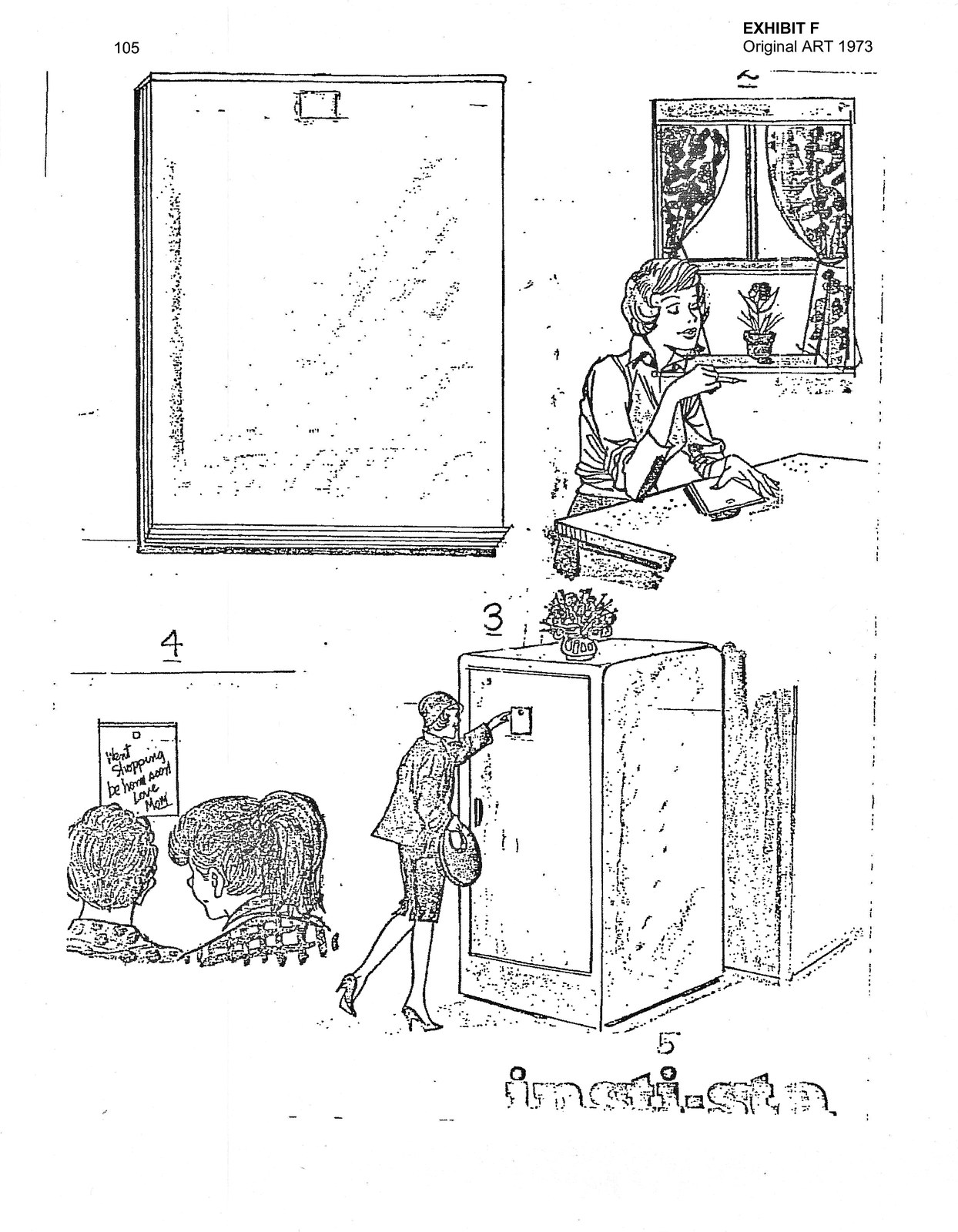
The concept artwork

The original concept rendering, made for me by graphic artist Steve Grossman, who also did the artwork for the Benihana restaurants.

Look at what the drawing is of. Not a product on a shelf. A hand writing a note, tearing it off, and pressing it onto a refrigerator door. The whole invention is in that gesture — the paper goes where the message belongs. Before there was a company, a mailing or an invoice, someone was paid to draw that.

The concept rendering by Steve Grossman, the graphic artist who did the Benihana restaurant artwork. It shows a memo sheet being placed on a refrigerator door and was filed in 1997, dated on or about February 1974, and filed again in 2016.

Original concept artwork for the Press-on Memo
Exhibit F.
Document 8

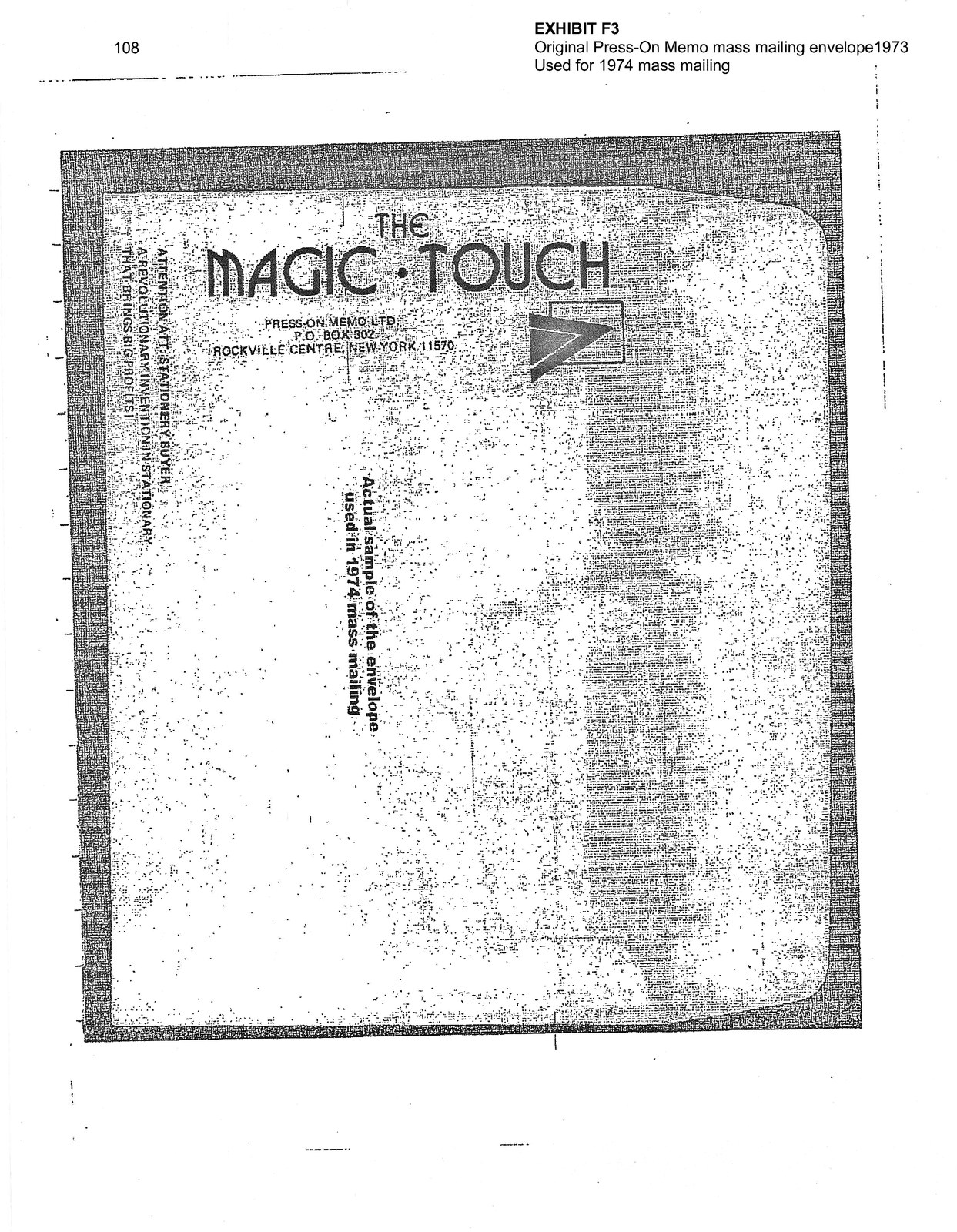
The 1974 mass mailing

With Press On Memo Ltd. incorporated and Box 302 open, I mailed roughly 2,000 pieces to buyers in the stationery trade — a sales sheet and a working sample in every envelope. The mailer's principal told me his stationery list held between 1,900 and 2,000 top-level executives: manufacturers, retail store chains, wholesale distributors.

The envelope carries the Press-On Memo Ltd. name and the Rockville Centre post office box recorded on the July 22, 1974 receipt.

Press-On Memo mass mailing envelope, 1974
Exhibit F3.
Document 9

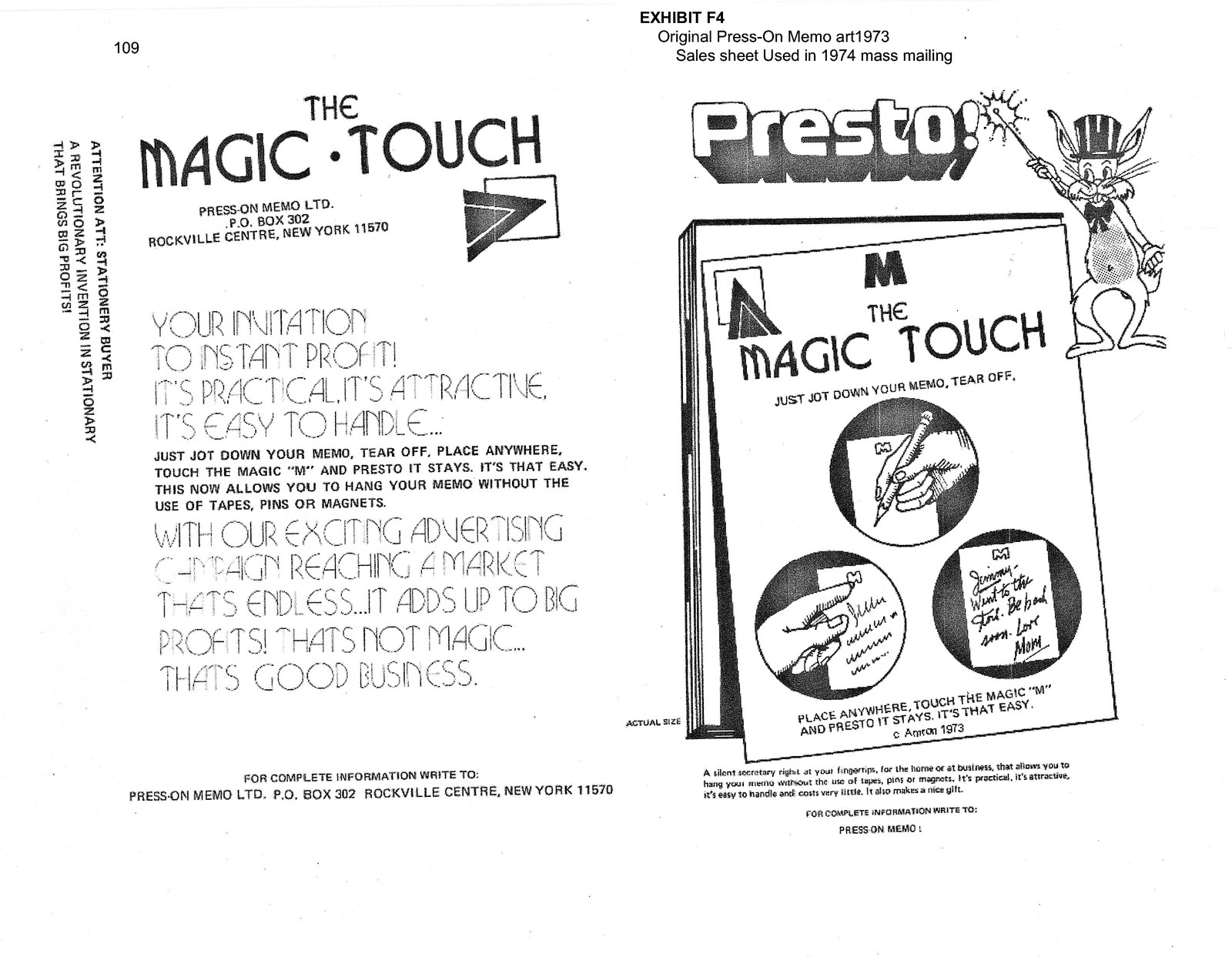
The sales sheet

The promotional material that went out in the mailing, addressed to stationery buyers. It called the product The Magic Touch: jot down your memo, tear it off, place it anywhere, and it stays — without the use of tapes, pins or magnets.

That sentence is the sticky note, described to the trade, in 1974, six years before 3M's national launch of Post-it Notes. Not a lab note or a private diary. A sales sheet, printed in quantity, mailed to people whose job was buying stationery.

A printed sales sheet with a © Amron 1973 notice, the return address at P.O. Box 302, Rockville Centre, and a retail price of $1.19 for three fifty-sheet pads.

Press-On Memo sales sheet, The Magic Touch
Exhibit F4.
Document 10

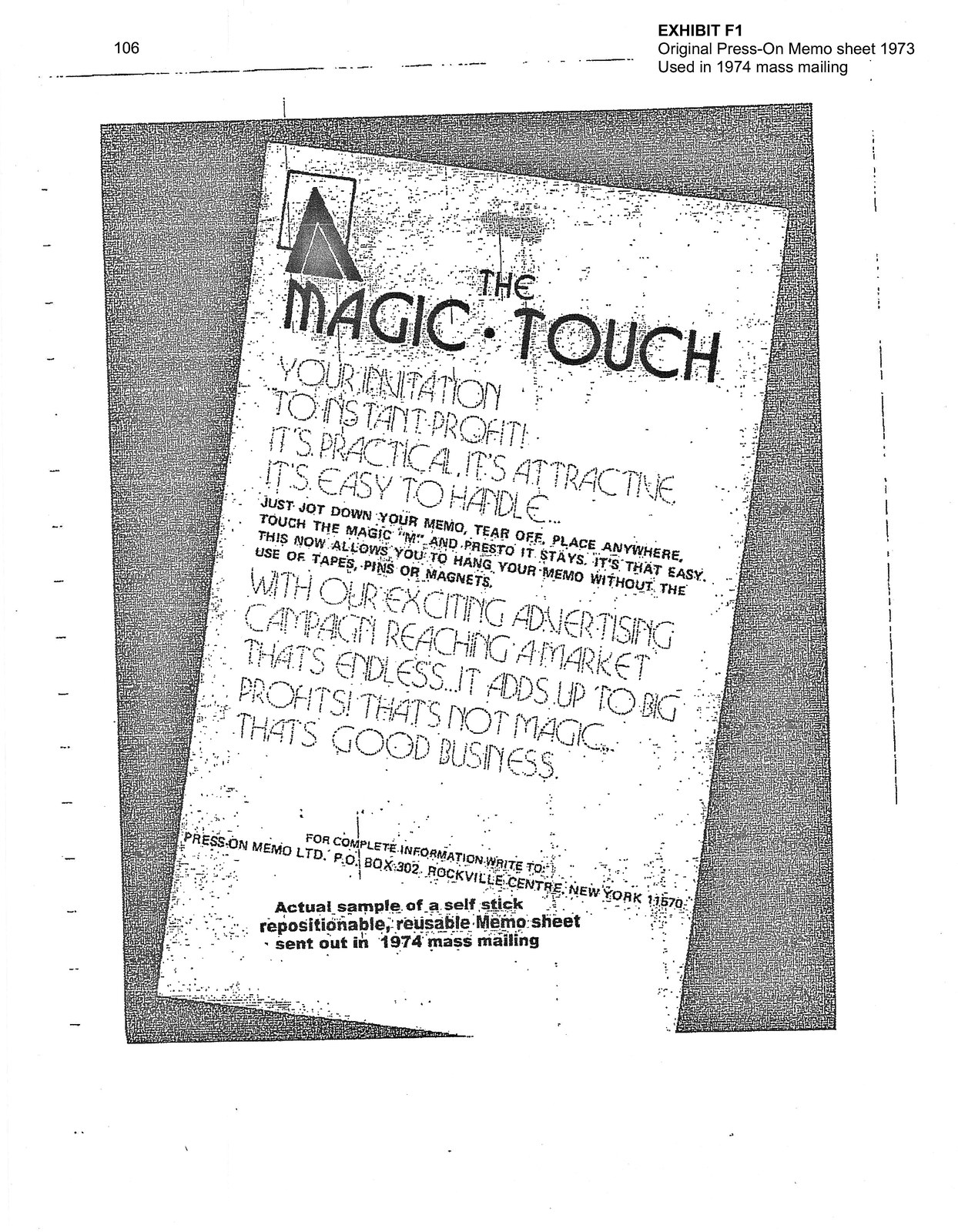
The memo sheet

Everything else on this page describes the invention. This is the invention. The Press-on Memo sheet itself, from the same 1974 mailing — not a drawing of it, not a description of it, not a lawyer's account of it. The paper.

Write on one. Tear it off. Press it where you need it and it stays. Lift it and it comes away clean. If you have ever used a sticky note you already know exactly what you are looking at, and you know what year it is from.

The product itself: a memo sheet with a repositionable, reusable adhesive on the back, so the note goes where the message belongs.

Press-On Memo sheet used in the 1974 mailing
Exhibit F1.
Document 11

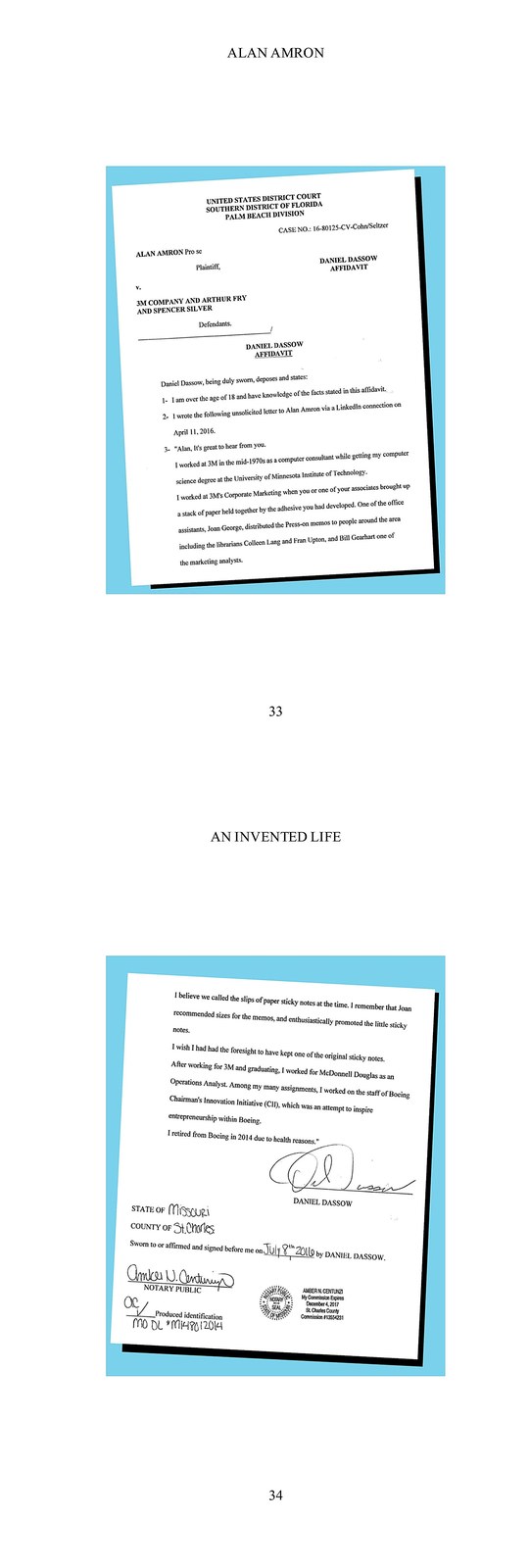
The affidavit of Daniel Dassow

Daniel Dassow worked at 3M as a computer consultant, in Corporate Marketing, while finishing his computer science degree at the University of Minnesota. He swore this affidavit on July 8, 2016 before a notary in Missouri, and it sets out an unsolicited message he wrote to me on April 11, 2016 after finding me through LinkedIn.

In it he says that Press-on memos were brought into 3M's Corporate Marketing, that an office assistant, Joan George, distributed them to people around the area — including librarians Colleen Lang and Fran Upton and marketing analyst Bill Gearhart — that he believes they were called slips of paper sticky notes at the time, and that Joan recommended sizes and promoted the little notes.

He came to me. A man I had never met found me online and wrote to say he remembered these notes inside 3M's Corporate Marketing department, then swore to it before a notary and let it be filed in a lawsuit against a company he once worked for. Nobody does that for a stranger's benefit.

Daniel Dassow worked in 3M Corporate Marketing in the mid-1970s and swore this affidavit in 2016. He describes Press-on Memos inside that department and names four colleagues he recalls there.

Affidavit of Daniel Dassow, sworn July 8, 2016
Filed in Amron v. 3M Minnesota Mining & Manufacturing Company, No. 16-80125 (S.D. Fla.), Docket Entry 63.
Document 12

The repositionable adhesive

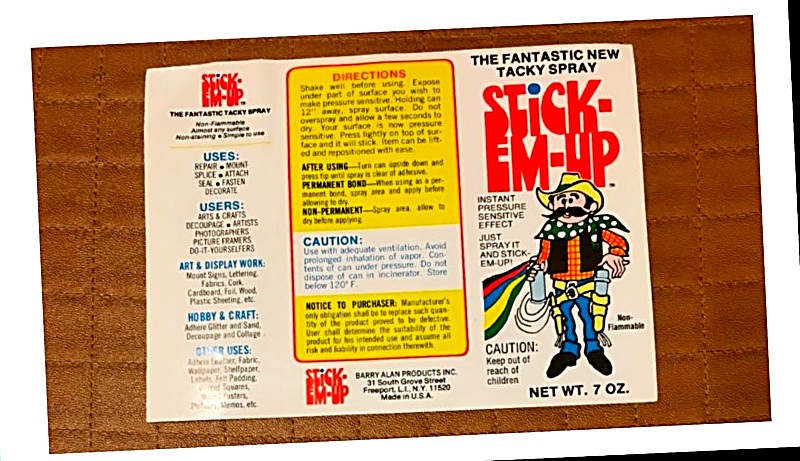
To make the Press-on Memo sheets and pads I needed an adhesive that would hold and then let go. I had one developed and I sprayed the sheets myself. The product was called Stick-Em-Up.

Its label describes an instant pressure sensitive effect and states that an item can be lifted and repositioned with ease. Barry Alan Products Inc., 31 South Grove Street, Freeport, New York.

Stick-Em-Up, the repositionable spray adhesive, sold in aerosol cans filled for me by Rite-Off Corp. of Plainview, New York. It is what made the memo sheets work.

Stick-Em-Up repositionable spray adhesive label
Filed in the federal record as Exhibit F6; reproduced from my color copy.
Document 13

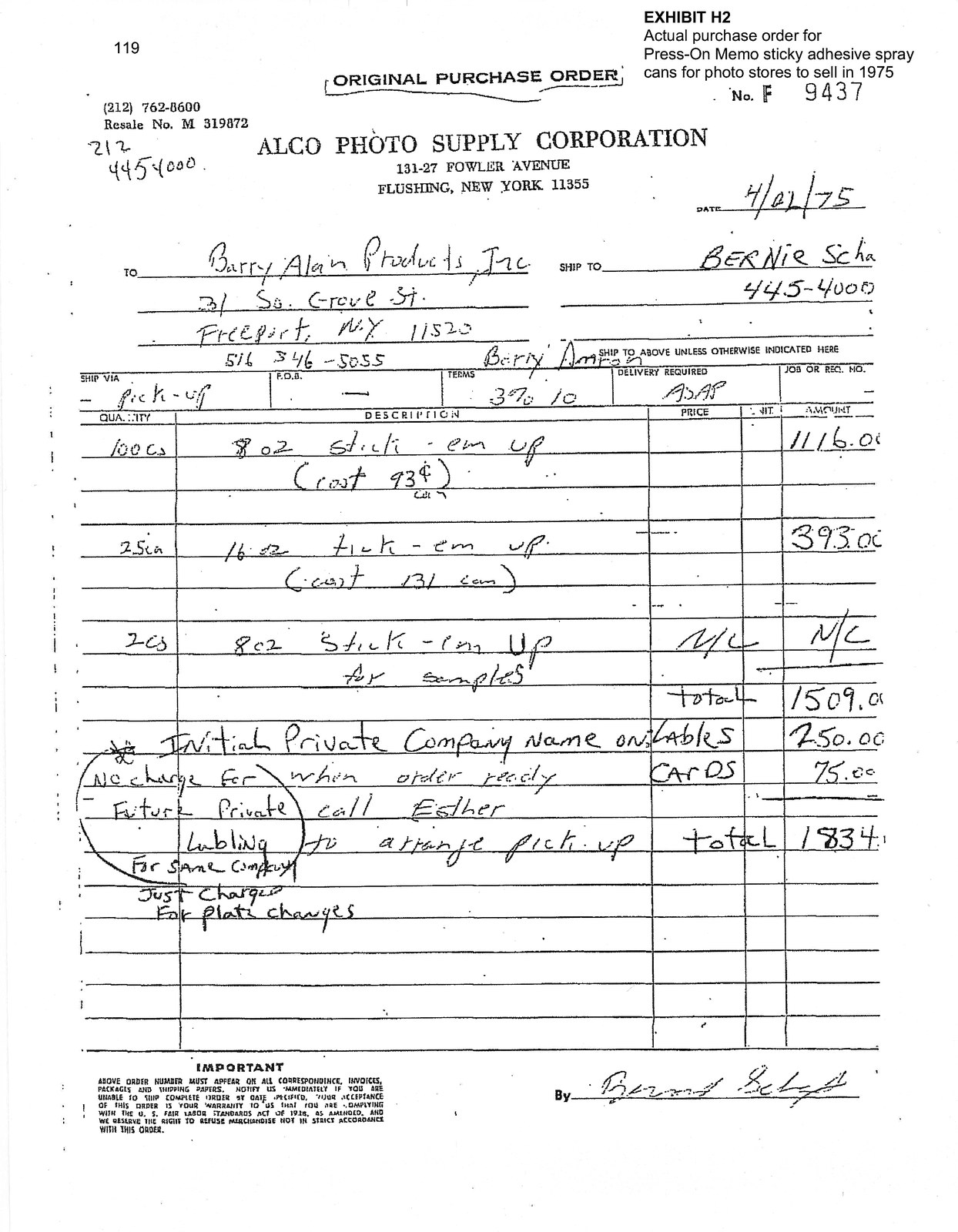
April 2, 1975 — Purchase order

The adhesive became a product of its own. This is a purchase order from Alco Photo Supply Corporation, dated April 2, 1975, ordering 125 cases of Stick-Em-Up.

Their form, their date, their signature. Not my document. Theirs.

Alco Photo Supply purchase order, April 2, 1975
Exhibit H2.
Document 14

May 1975 — Invoice and payment

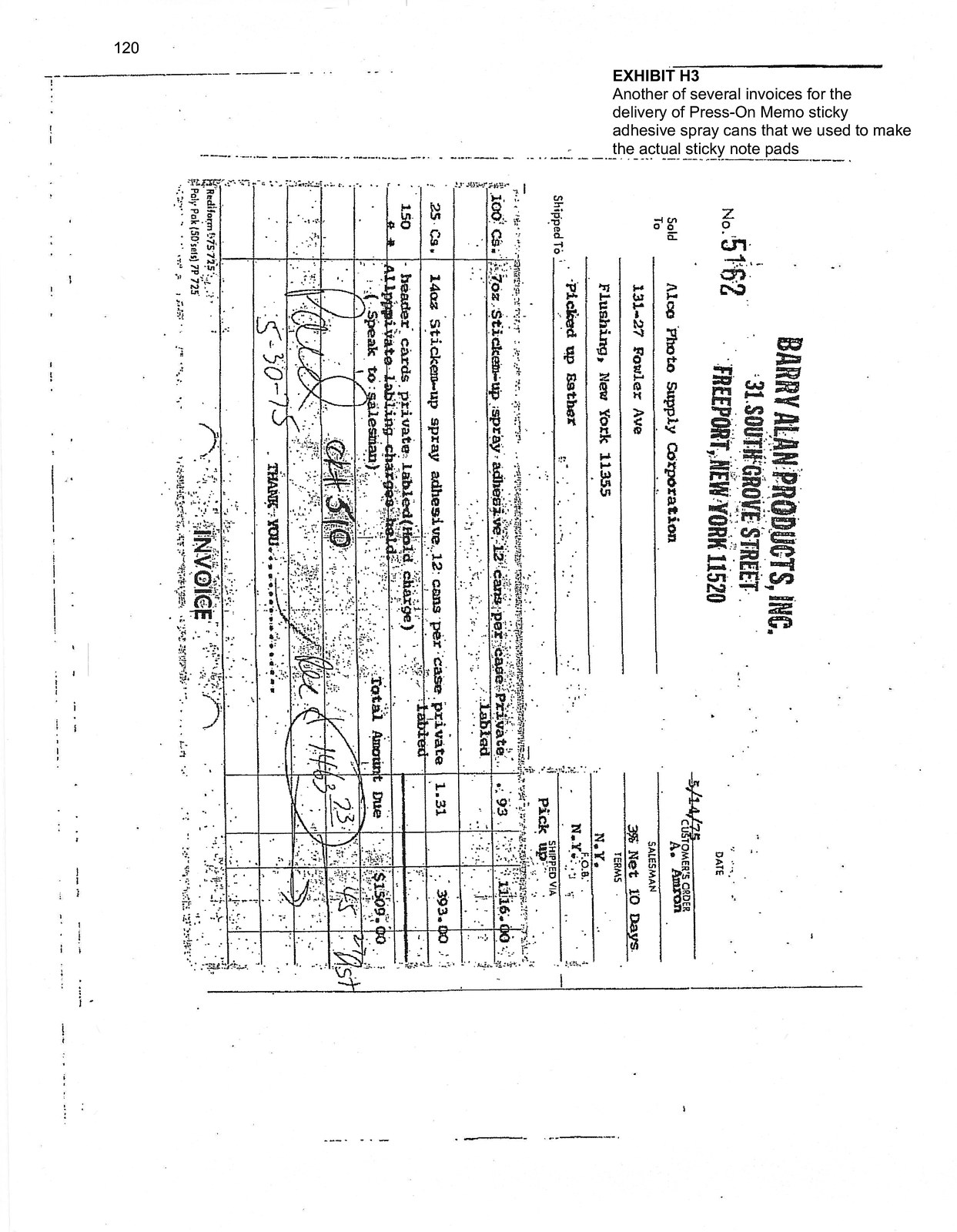
The order was filled. Invoice 5162 from Barry Alan Products to Alco Photo Supply, dated May 14, 1975, for 125 cases of Stick-Em-Up, private labeled. $1,509.00. Marked paid May 30, 1975.

A purchase order shows an intention. An invoice marked paid shows a transaction.

Barry Alan Products invoice 5162, May 14, 1975, marked paid
Exhibit H3.
Document 15

March–May 1975 — The rest of the invoices

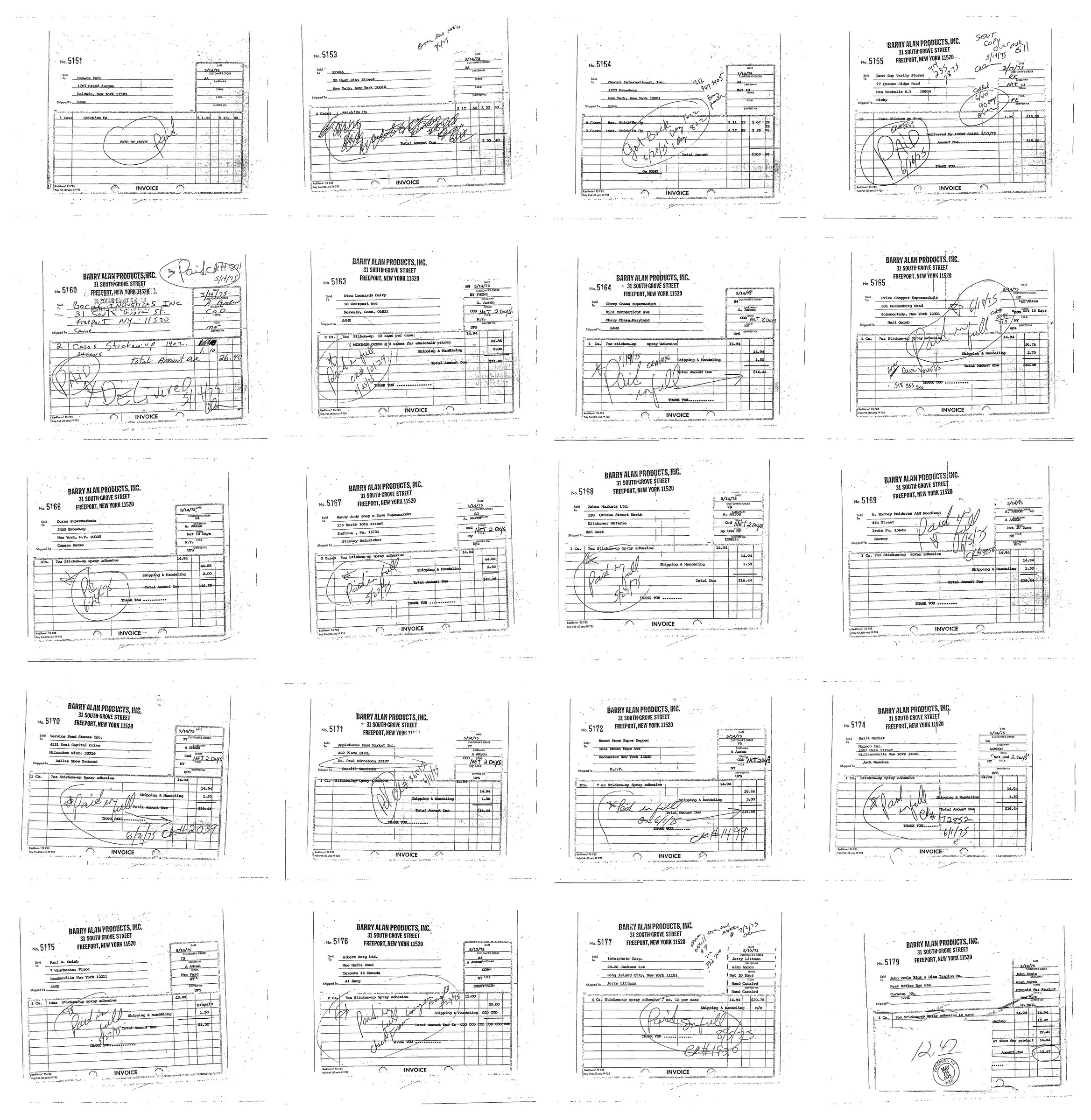
Document 14 is one of them. Here is the rest of the run: No. 5151 through No. 5179, dated between March 14 and May 19, 1975, all on Barry Alan Products letterhead, all for Stick-Em-Up.

Read the names. Price Chopper Supermarkets in Schenectady. Stew Leonard's Dairy in Norwalk. Zehrs Markets in Kitchener, Ontario. Applebaum's Food Market in St. Paul. Durso Supermarkets on Broadway. Handy Andy Shop n Save in Indiana, Pennsylvania. Service Food Stores in Milwaukee. Chevy Chase Supermarket in Maryland. Mount Hope Super Duper in Rochester. Interphoto in Long Island City. Camera Fair in Baldwin. Gemini International. Albert Berg Ltd. in Toronto. Blok & Diaz Trading in Curaçao.

Six states, Canada and the Caribbean, inside ten weeks, on one continuous run of numbered forms. Not a prototype. An order book.

And look where Document 14 sits. The Alco invoice on the page above this one is No. 5162 — inside this same run, between the Stew Leonard's invoice and the Mount Hope invoice. It was never a single sale standing on its own. It was one page torn out of a book that was being written all spring.

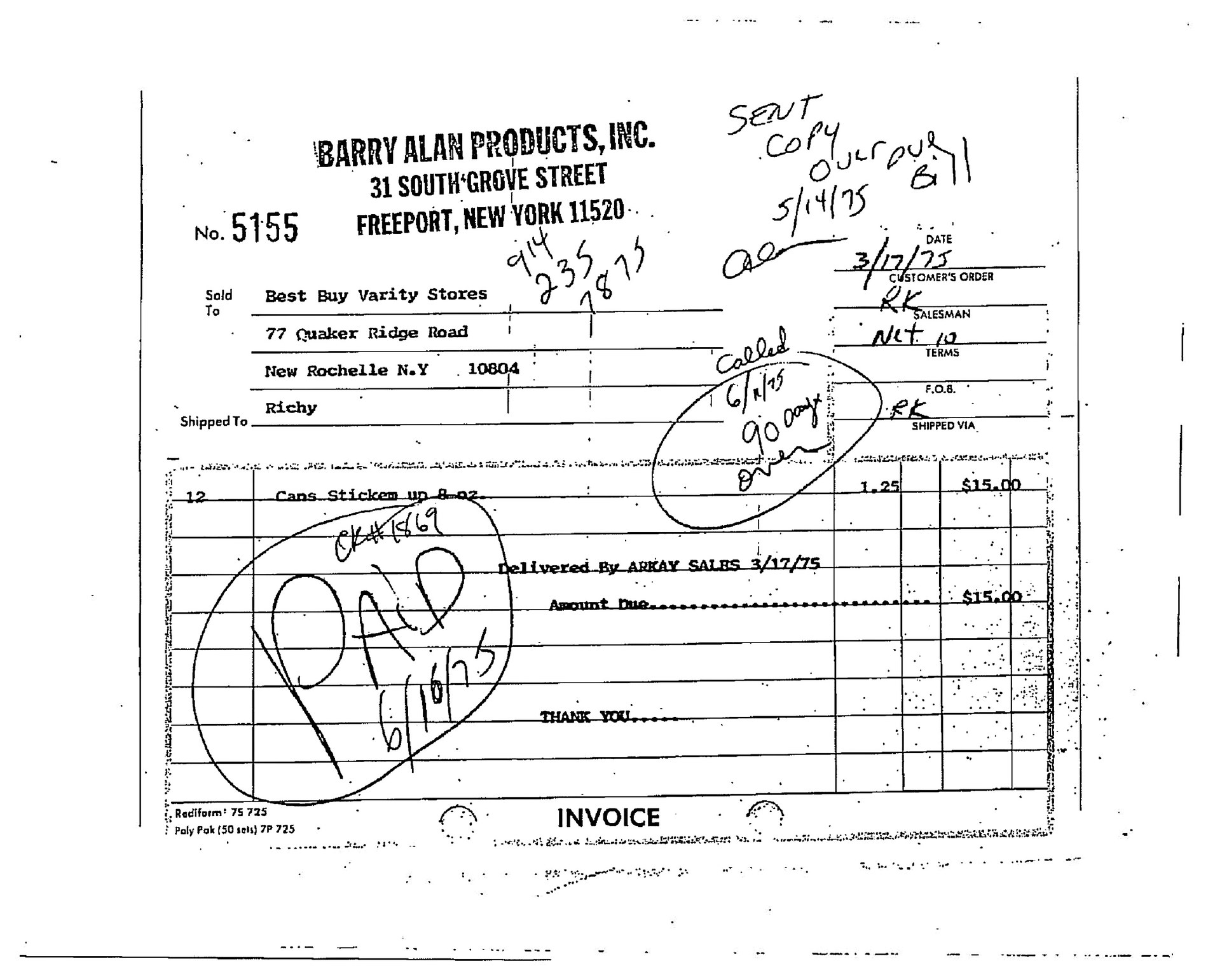
Now look at two names in the run. No. 5155, March 17, 1975, is typed across the middle: delivered by Arkay Sales. Arkay Sales, Inc. is the stationery rep group my investor named in his sworn affidavit in Document 17, whose president he names as Ronald Katz; the salesman box on that invoice reads RK. And No. 5153 is made out to Kroma, 30 West 21st Street — Kroma Lithographers, the New York printer who printed my Press-on Memo sheets, flyers and envelopes in 1974.

Two names from the 1974 story, appearing on 1975 business forms that were never written to prove anything. The affidavit and the invoices were made twenty-two years apart, by different hands, for different purposes, and they match.

Nineteen more invoices from the same numbering run, No. 5151 through No. 5179, March 14 to May 19, 1975, to supermarkets, camera dealers and importers in New York, Minnesota, Wisconsin, Maryland, Ontario and Curaçao. One of them, No. 5155, is annotated Delivered By ARKAY SALES — the rep group Jeffrey Brown names in his affidavit twenty-two years later.

Twenty Barry Alan Products invoices, March to May 1975
Filed as Exhibit #29 in Amron v. 3M, CV-97-7281 (E.D.N.Y.); the Alco purchase order in Document 14 is Exhibit #28. Contrast adjusted for legibility; no content altered.
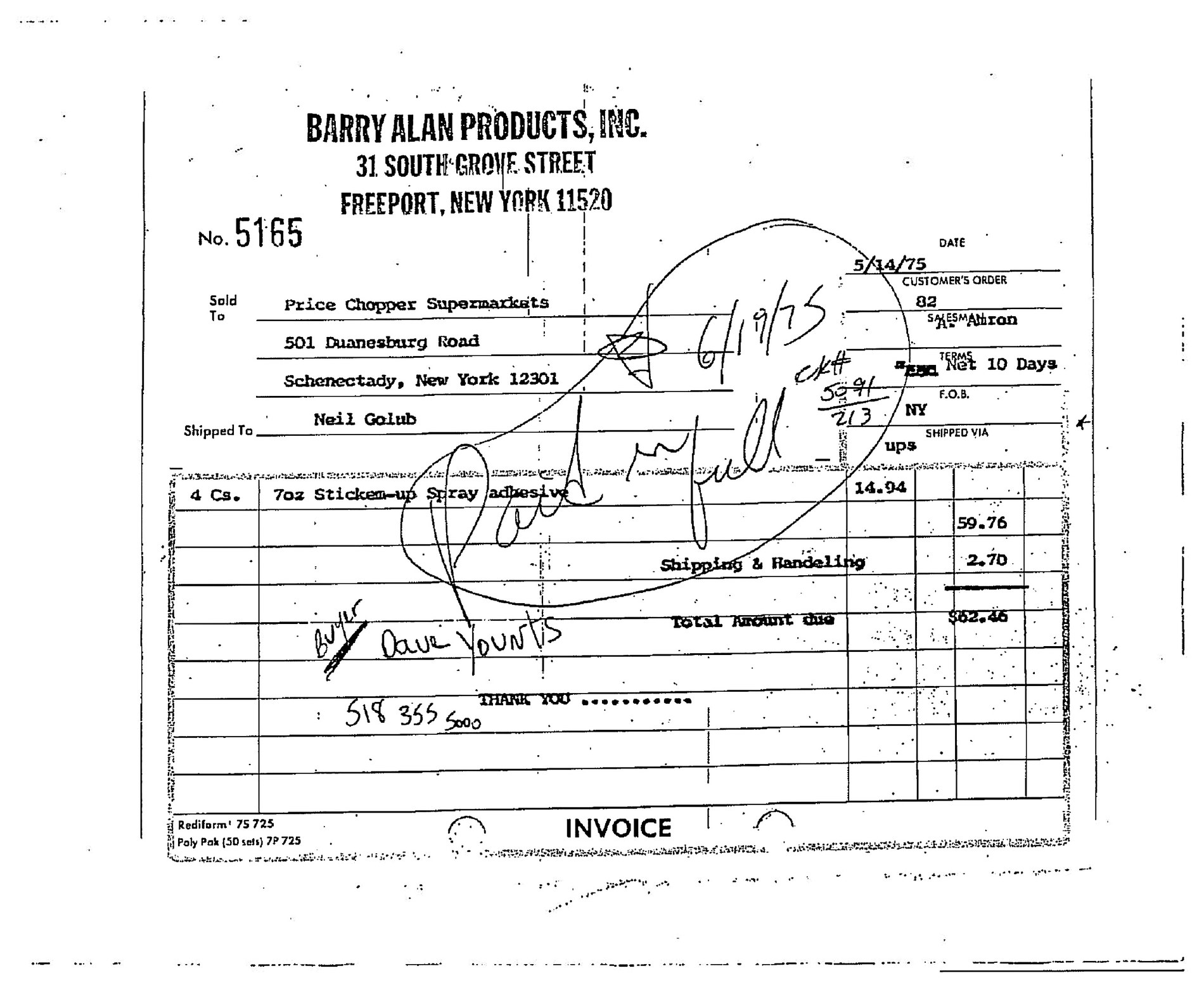
Barry Alan Products invoice 5165 to Price Chopper Supermarkets, May 14, 1975
No. 5165 — Price Chopper Supermarkets, Schenectady, New York. Four cases.
Barry Alan Products invoice 5155, delivered by Arkay Sales, March 17, 1975
No. 5155 — Best Buy Variety Stores, New Rochelle. Annotated: delivered by Arkay Sales, 3/17/75.
Document 16

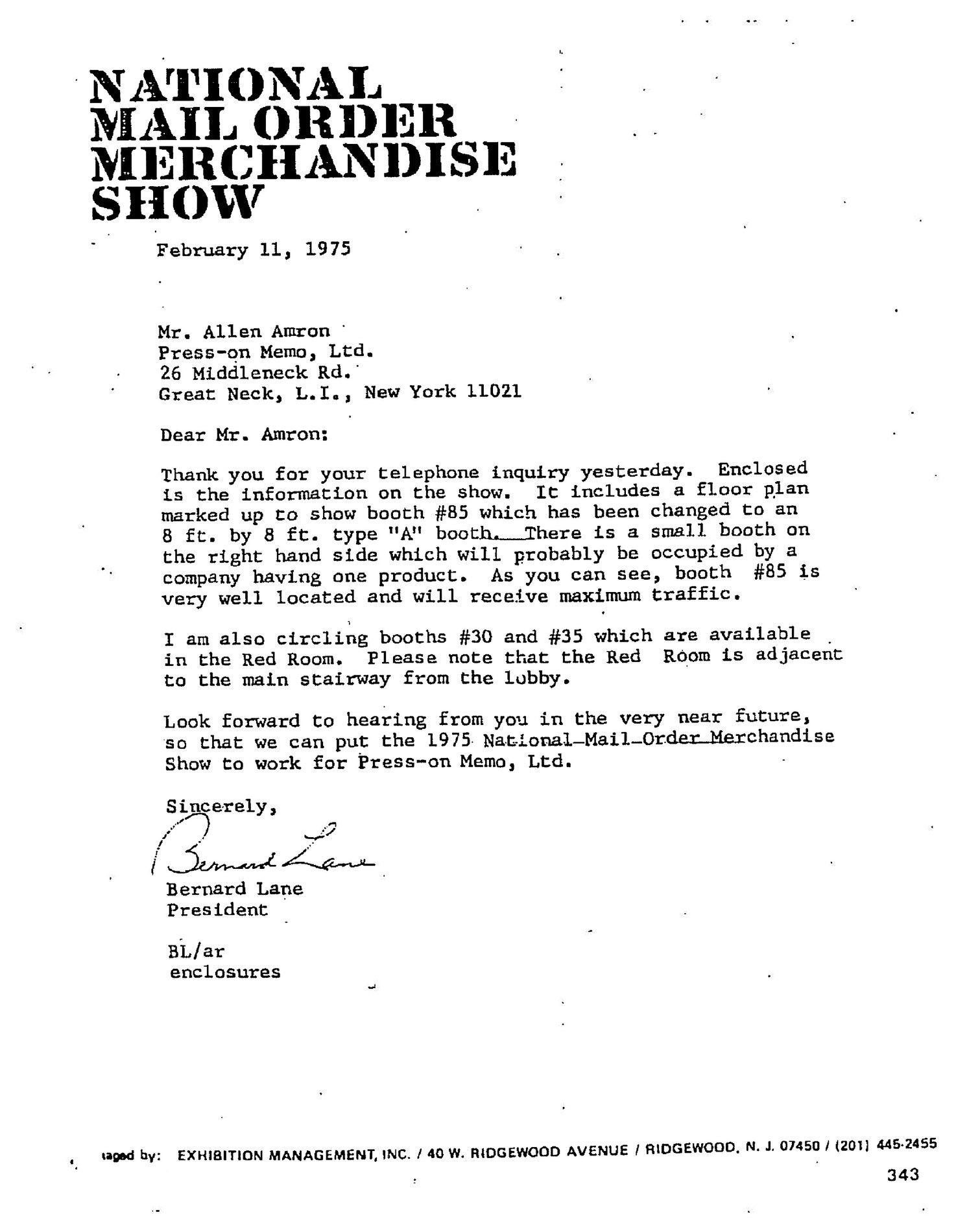
February 11, 1975 — The National Mail Order Merchandise Show

A letter from Bernard Lane, President of Exhibition Management, Inc., the company that produced the National Mail Order Merchandise Show, to Press-on Memo, Ltd. He has marked up a floor plan, changed booth #85 to an eight-by-eight, notes that it will get maximum traffic, and offers booths #30 and #35 in the Red Room as alternatives.

Every corporate record above proves the company was filed. This proves it was being courted. A show promoter took the trouble to hold floor space for Press-on Memo, Ltd. and to write about it on his own letterhead.

The letter confirms booth #85 for Press-on Memo, Ltd. at the 1975 National Mail Order Merchandise Show, and is addressed to the company at 26 Middle Neck Road, Great Neck.

Letter from the National Mail Order Merchandise Show to Press-on Memo Ltd., February 11, 1975
Filed in Amron v. 3M, CV-97-7281 (E.D.N.Y.).
Document 17

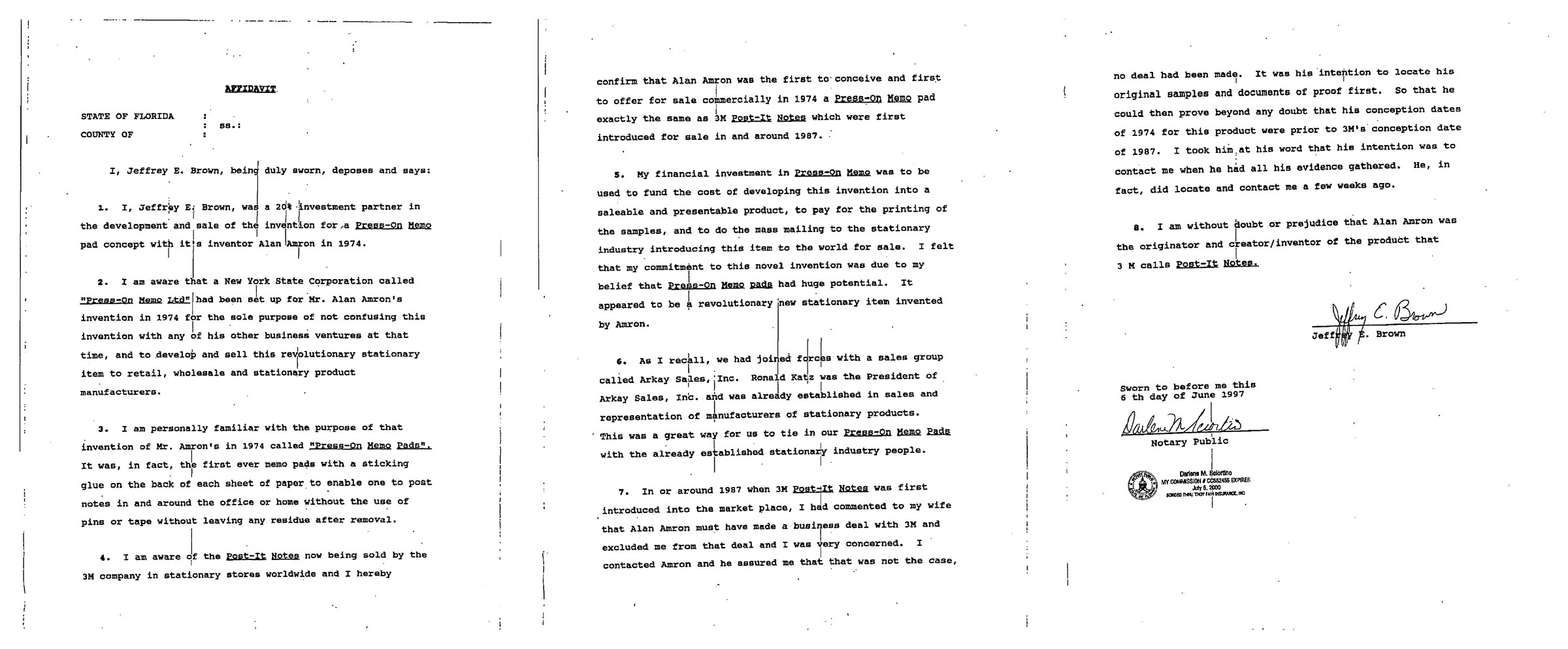
The affidavit of Jeffrey Brown

Jeffrey E. Brown was a twenty percent investment partner in Press-On Memo. He swore this affidavit on June 6, 1997, under oath, and it was filed in federal court.

He states what his money paid for: developing the invention into a saleable product, the printing of the samples, and the mass mailing to the stationery industry. That is Document 8 and Document 9, described by the man who financed them, from the other side of the transaction.

He describes the product in his own words — the first ever memo pads with a sticking glue on the back of each sheet, to post notes around the office or home without pins or tape and without leaving any residue. And he says we joined forces with Arkay Sales, Inc., president Ronald Katz, to reach the established stationery trade. Arkay's name appears again, in typescript, on a 1975 invoice in Document 15.

Jeffrey Brown was a twenty percent investment partner in the venture. His money funded developing the product, printing the samples and the 1974 mass mailing, and he swore to it in 1997. His paragraph 6 names Arkay Sales, Inc. and its president Ronald Katz — the same rep group annotated on invoice No. 5155.

Affidavit of Jeffrey E. Brown, investment partner in Press-On Memo, sworn June 6, 1997
Filed in CV-97-7281 (E.D.N.Y.) and again as Exhibits G/G1/G2 in No. 16-80125 (S.D. Fla.). Three pages, shown side by side.
Document 18

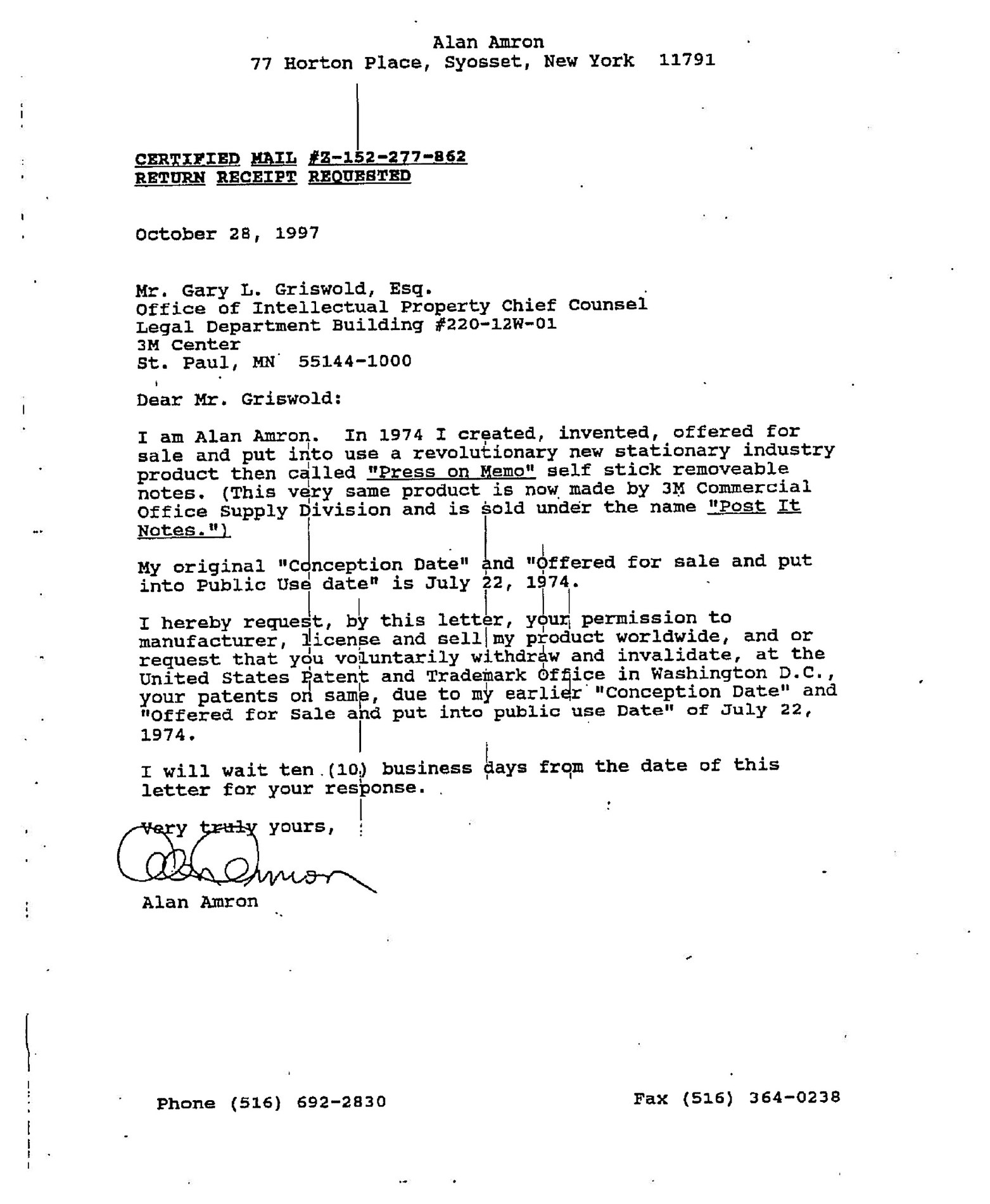
October 28, 1997 — I write to 3M

Twenty-three years after the exhibition I wrote to Gary L. Griswold, Chief Counsel of 3M's Office of Intellectual Property, by certified mail, return receipt requested. Not to a press office. To the lawyer whose job was the company's patents.

In it I set out my conception and offered-for-sale date as July 22, 1974 — the same date as the Post Office receipt in Document 3 and the letter to my patent attorney in Document 2 — and I asked 3M for permission to manufacture and sell my product worldwide, and asked it to voluntarily withdraw and invalidate its patents in light of that date. I gave them ten business days.

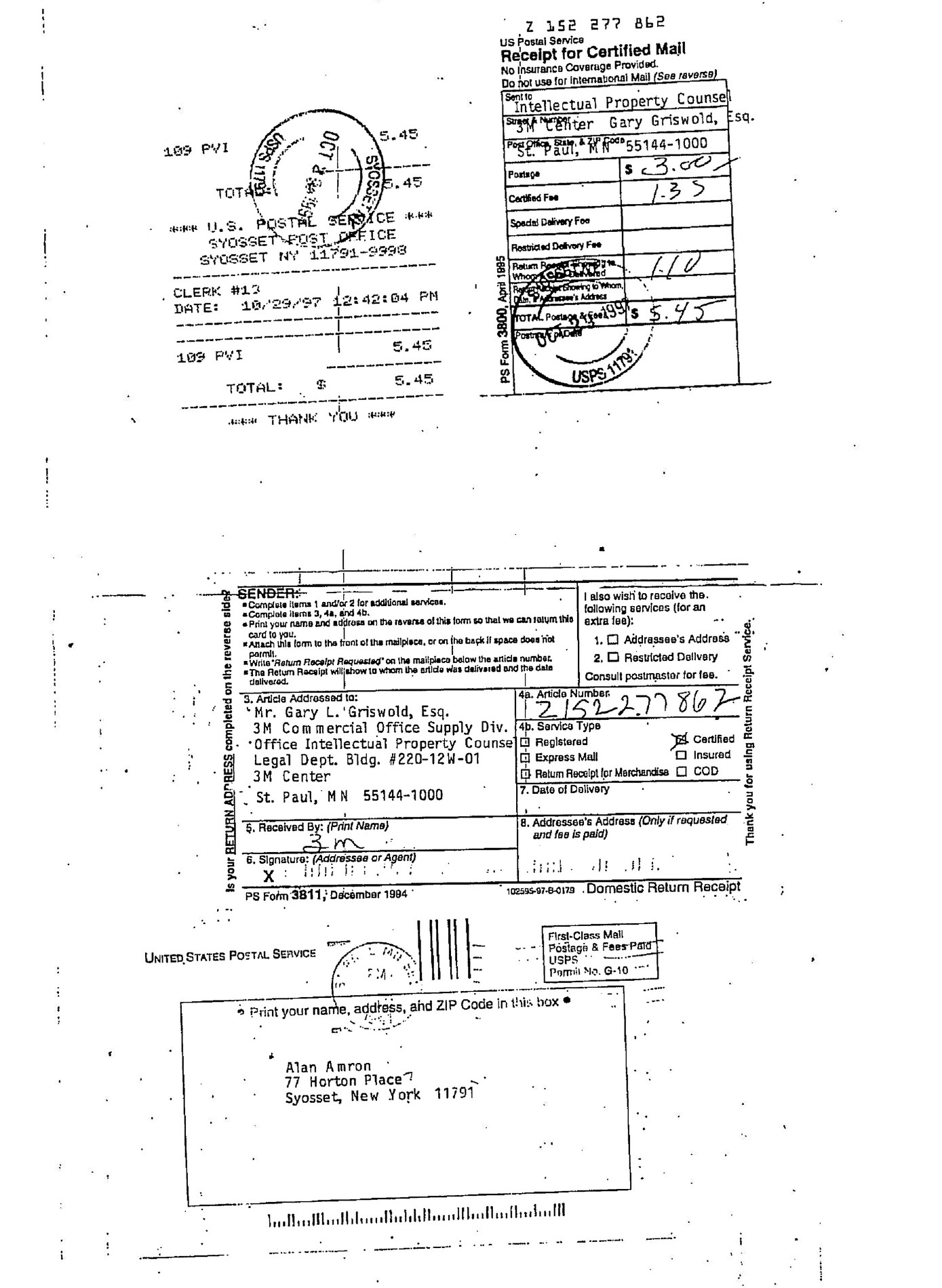
The proof of delivery is here too. Certified article Z 152 277 862, mailed at the Syosset post office on October 29, 1997, and the return receipt card signed on delivery, marked received by 3M. There is no version of this story where 3M did not receive it. I sued that December.

The letter went out certified, article Z 152 277 862, from the Syosset post office on October 29, 1997. The return receipt came back signed and marked received by 3M.

Certified letter to Gary L. Griswold, 3M Chief Intellectual Property Counsel, October 28, 1997
Filed in CV-97-7281 (E.D.N.Y.).
Certified mail receipt and signed return receipt for the October 1997 letter to 3M
Certified article Z 152 277 862 and the signed return receipt.
Document 19

January 1998 — Clause 6

Everything above this line is mine. My letter, my artwork, my company, my product, my invoices, my witnesses. That is what an inventor's archive is, and I have never pretended otherwise.

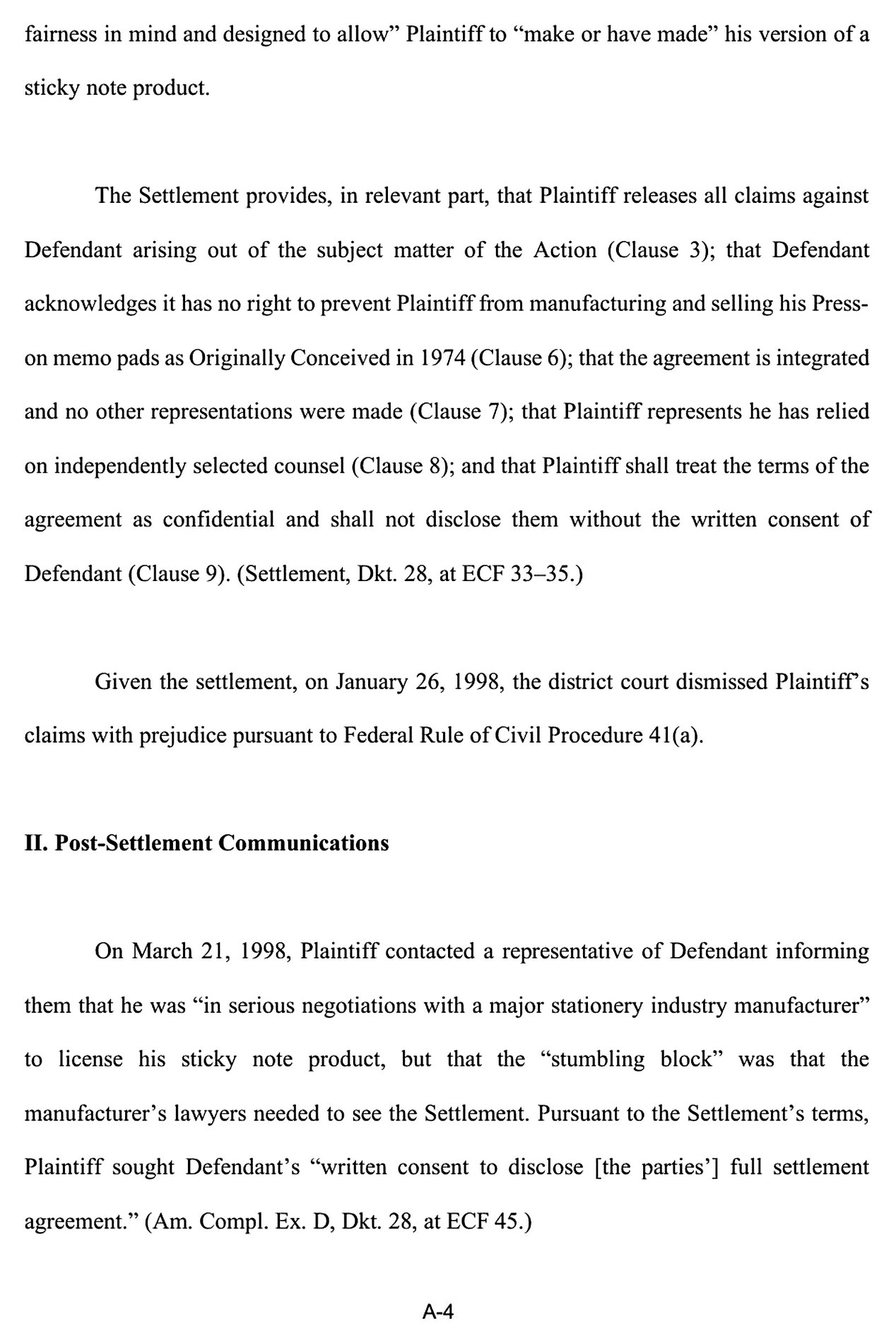
This one is not mine. It is a federal court's own recitation of what the 1998 settlement says, and it records that 3M acknowledged it has no right to prevent me from manufacturing and selling my Press-on memo pads as originally conceived in 1974.

As originally conceived in 1974. My product, my year, in an agreement 3M's lawyers negotiated and signed. They did not have to write it that way. They could have written 1997. They could have written nothing.

Why I settled

Not for money. 3M paid $12,000, and my filing and research costs were already $11,090. I walked away from that lawsuit with about nine hundred dollars.

I settled for Clause 6. I had spent twenty-four years being told the sticky note was not mine to make. Clause 6 said I could make it. To an inventor that is not a legal term, it is a factory, a licensing deal, a product on a shelf with my name behind it. On its face I had just won the thing I actually wanted.

Paragraph 9, four clauses further down, said I could not show the agreement to anyone without 3M’s written consent. At the signing I understood the confidentiality commitment to run both ways. Eight weeks later, when I needed to show Clause 6 to a prospective licensee, 3M refused consent to disclose the agreement — and put its understanding in writing by referring to the confidentiality commitment “from either side.” Document 20 →

In Clause 6 of the January 1998 settlement, 3M agreed it had no right to prevent me from manufacturing and selling my Press-on memo pads as originally conceived in 1974.

Court appendix page reciting Clause 6 of the 1998 settlement agreement
From the publicly filed appendix in Amron v. 3M Company, No. 26-5031 (U.S.). The court's recitation of the settlement terms, not the agreement itself.
Document 20

March 21 – April 6, 1998 — The right, and the door

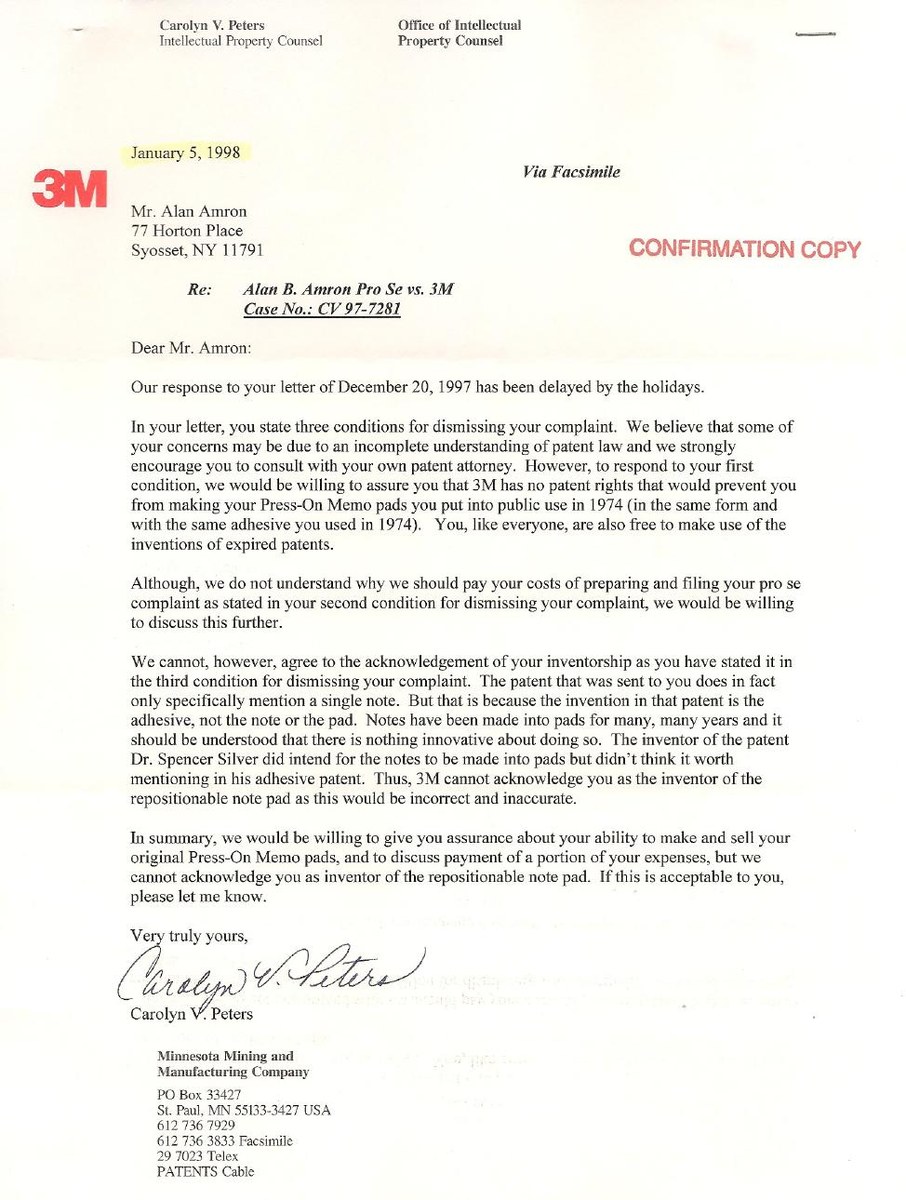
Clause 6 was the whole reason I settled. 3M had put it in writing on January 5, 1998, before we signed: it had no patent rights that would prevent me from making my Press-on Memo pads as I put them into public use in 1974, in the same form and with the same adhesive. That was worth more to me than money. It meant I could finally build the thing.

Eight weeks later I nearly did.

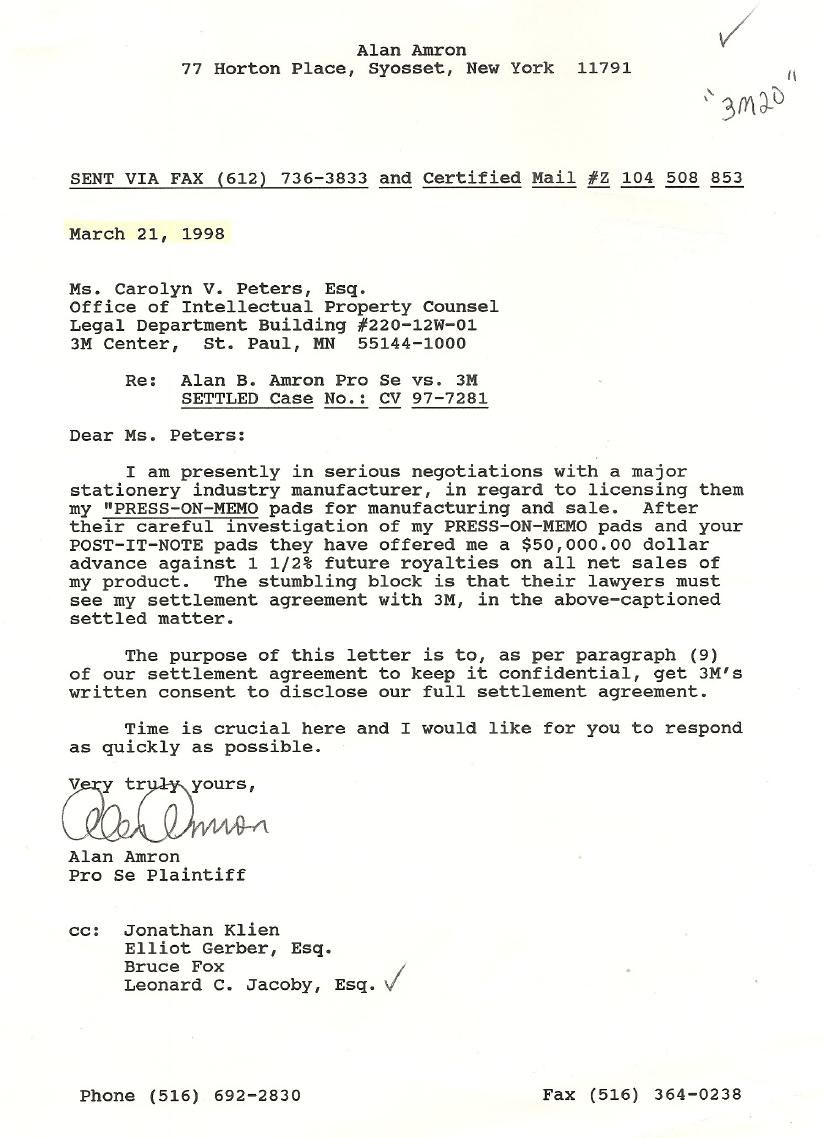
On March 21, 1998 I wrote 3M's intellectual property counsel by fax and by certified mail. I was in serious negotiations with a major stationery industry manufacturer — Avery Dennison, 3M’s largest competitor in stationery — to license the Press-on Memo for manufacturing and sale. After investigating my pads and 3M's, they had offered me a $50,000 advance against a royalty of one and a half percent on all net sales. One thing stood in the way. Before Avery Dennison would license a product from me, its lawyers had to satisfy themselves that I actually held the right to license it — that 3M could not come after them for making my pads. The only proof of that right was Clause 6, and Clause 6 was inside the settlement agreement. Paragraph 9 said I needed 3M's written consent to show that agreement to anyone. So I asked for consent, and I told them time was crucial.

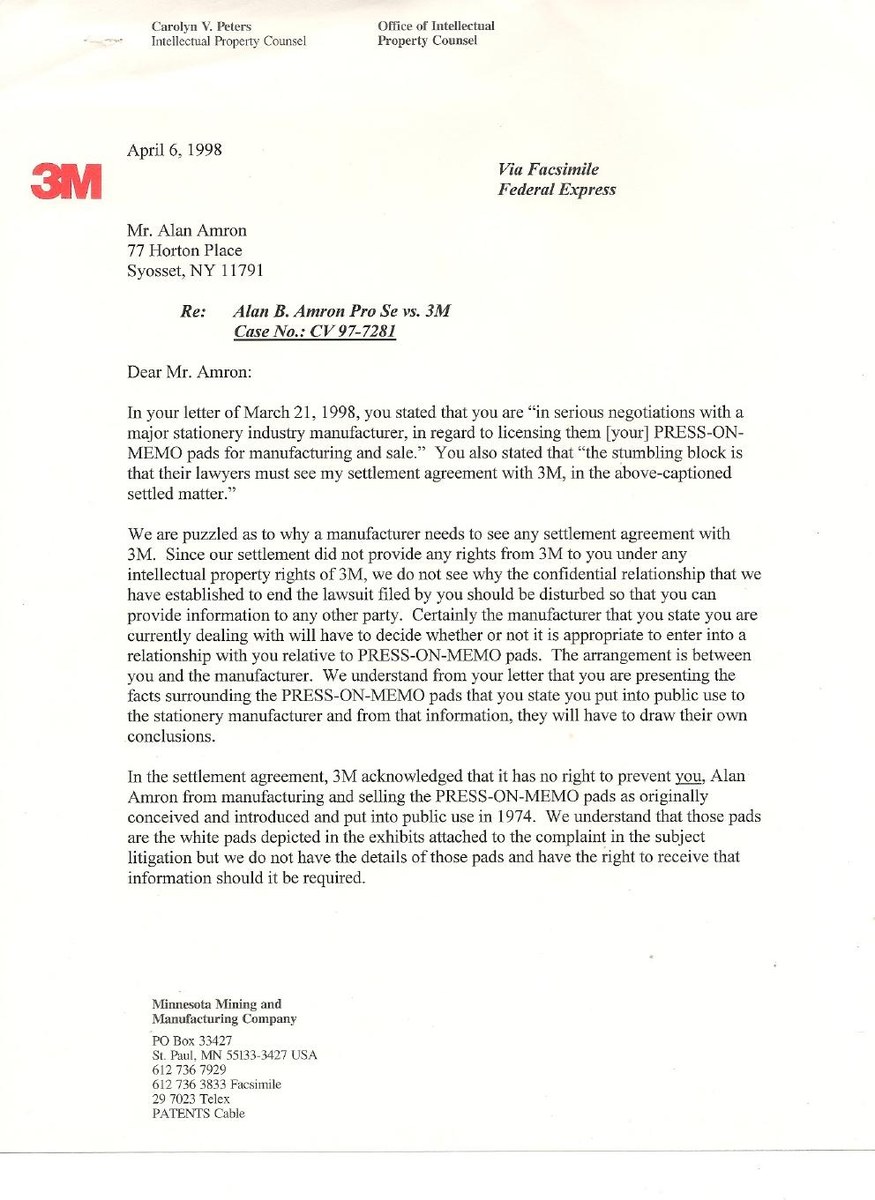
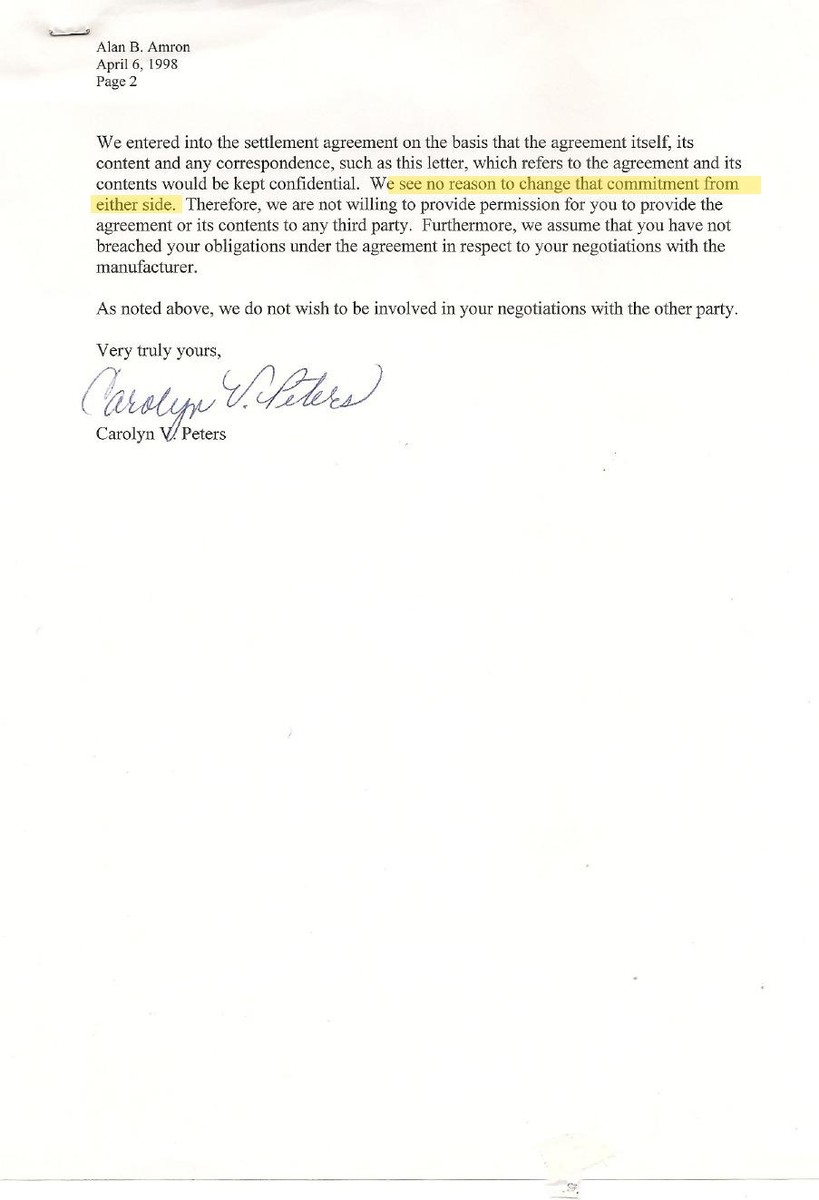
3M answered on April 6. It said it was puzzled as to why a manufacturer would need to see any settlement agreement with 3M. It said it had entered into the agreement on the basis that the agreement, its contents, and correspondence about it would be kept confidential, and that it saw no reason to change that commitment from either side. It was not willing to give permission. It added that it did not wish to be involved in my negotiations with the other party.

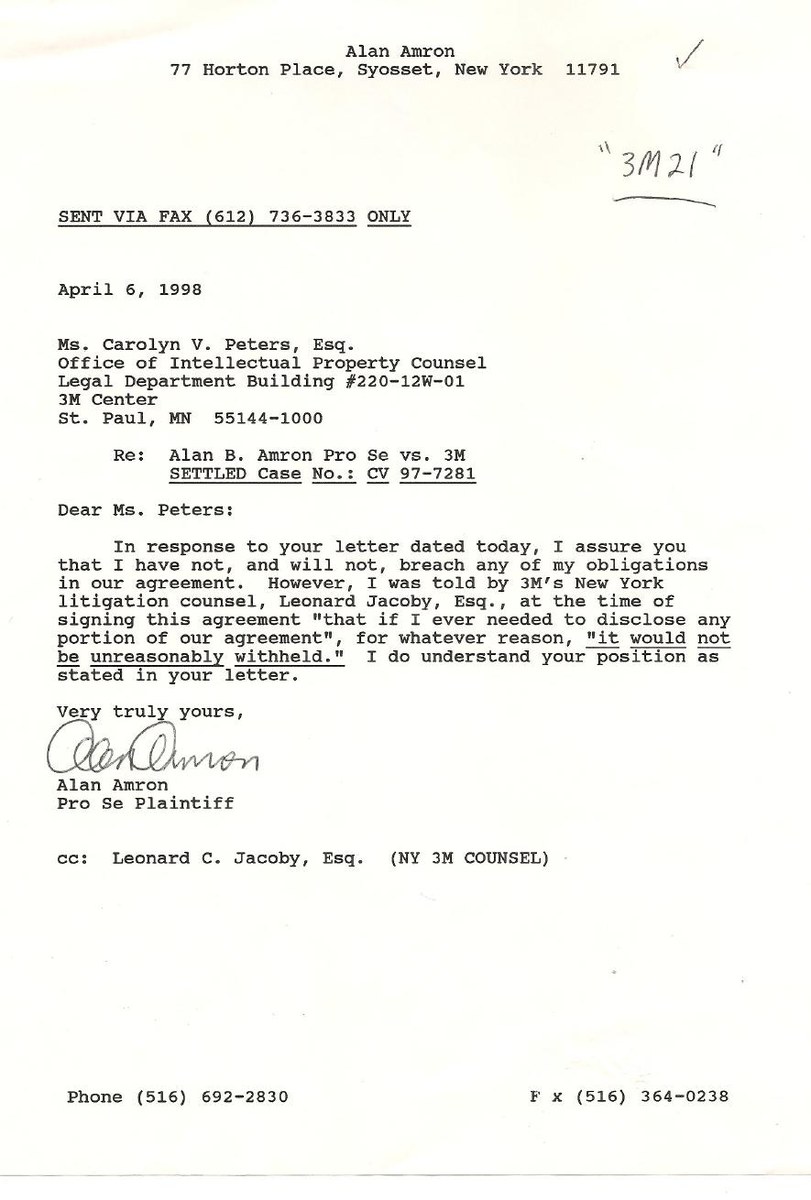
I answered the same day. I told them what 3M's New York litigation counsel, Leonard Jacoby, had told me at the signing: that if I ever needed to disclose any portion of the agreement, for whatever reason, consent would not be unreasonably withheld. I copied Jacoby on the letter. No one wrote back to say I had it wrong.

The license did not happen. I was never trying to publicize the settlement — I was trying to prove I had the right to license my own product without 3M interfering, and 3M held the only document that proved it. No manufacturer signs a license on a stranger’s word.

Clause 6 gave me the right. Paragraph 9 made it impossible to prove. Read separately they are ordinary. Read together they are a door with a lock on the inside, and 3M held the key. That is what fifty thousand dollars and a royalty on every pad walked away from.

I am not saying 3M was obliged to consent. I am saying that a right you are forbidden to demonstrate is not worth what it appears to be worth, and that the two clauses were written by the same lawyers on the same day.

A separate matter — the confidentiality itself

Look again at what 3M wrote on April 6, 1998. It did not say the clause bound me. It said it saw no reason to change that commitment from either side.

From either side. I understood that in 1998 to mean the confidentiality commitment was mutual, and for twenty-six years I treated the settlement accordingly. I never showed the agreement to anyone, and I never asked again after 1998.

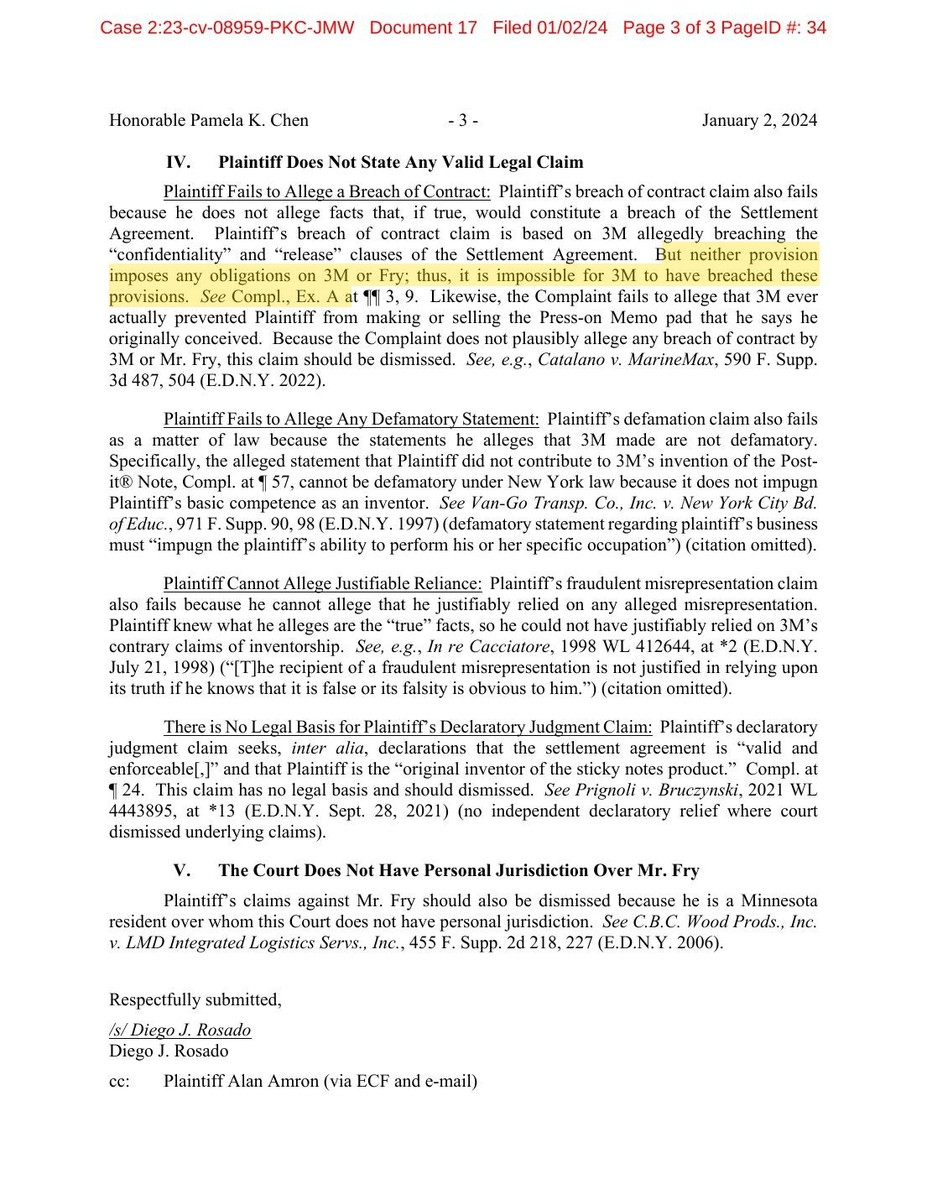
In January 2024, in a federal court, 3M asserted that Clause 9 imposed no obligation on 3M.

It is below, in their own filing. On January 2, 2024, 3M's counsel wrote to Judge Pamela K. Chen in the Eastern District of New York that my breach of contract claim was based on 3M allegedly breaching the confidentiality and release clauses of the settlement — and that neither provision imposes any obligations on 3M or Fry, so it is impossible for 3M to have breached them. The citation immediately after that sentence is to paragraphs 3 and 9 of the agreement. Paragraph 9 is the confidentiality clause.

Set the two side by side. April 6, 1998: no reason to change that commitment from either side. January 2, 2024: that provision imposes no obligations on 3M at all.

Page three of 3M's January 2, 2024 pre-motion letter to Judge Pamela K. Chen, stating that the confidentiality and release provisions impose no obligations on 3M or Fry
3M's pre-motion letter, Amron v. 3M Minn. Mining & Mfr. Co. and Arthur Fry, No. 2:23-cv-08959 (E.D.N.Y.), Document 17, filed January 2, 2024, page 3 of 3, PageID #34. Public on the court's docket. Highlighting is mine, added to mark the sentence; the text is untouched.

That is a different grievance from the one above, about a different clause, arising twenty-six years later. It is not about sticky notes at all. It is about whether a company can hold a man to a promise for twenty-six years and then tell a judge the promise was never mutual. It is the issue presented in my pending petition to the Supreme Court.

My letter of March 21, 1998, sent by fax and by certified mail no. Z 104 508 853, and 3M's reply of April 6, 1998 — both from my own file, both filed in my 2016 case. The court's recitation of the same letter follows them.

Letter from Carolyn V. Peters, 3M Office of Intellectual Property Counsel, to Alan Amron, January 5, 1998
3M, January 5, 1998, before the settlement was signed: no patent rights that would prevent me from making my Press-On Memo pads as I put them into public use in 1974, in the same form and with the same adhesive.
Alan Amron letter to Carolyn V. Peters of 3M, March 21, 1998, requesting written consent to disclose the settlement agreement to a stationery manufacturer offering a $50,000 advance
My letter of March 21, 1998 to 3M's Office of Intellectual Property Counsel. Sent by fax and by certified mail.
Letter from Carolyn V. Peters, 3M Office of Intellectual Property Counsel, to Alan Amron, April 6, 1998, page one
3M's answer, April 6, 1998, page one. On 3M letterhead, quoting my March 21 letter back to me — and acknowledging that 3M has no right to prevent me from manufacturing and selling the Press-On-Memo pads as originally conceived and put into public use in 1974.
Letter from Carolyn V. Peters of 3M to Alan Amron, April 6, 1998, page two, refusing permission to disclose the settlement agreement
Page two. Not willing to provide permission, and no reason to change that commitment from either side. Highlighting is mine, added to mark the sentence; the text is untouched.
Alan Amron letter to Carolyn V. Peters of 3M, April 6, 1998, replying the same day and citing Leonard Jacoby's statement that consent would not be unreasonably withheld
My reply the same day, copied to Leonard C. Jacoby, 3M's New York litigation counsel: what he told me at the signing — that if I ever needed to disclose any portion of the agreement, for whatever reason, it would not be unreasonably withheld.
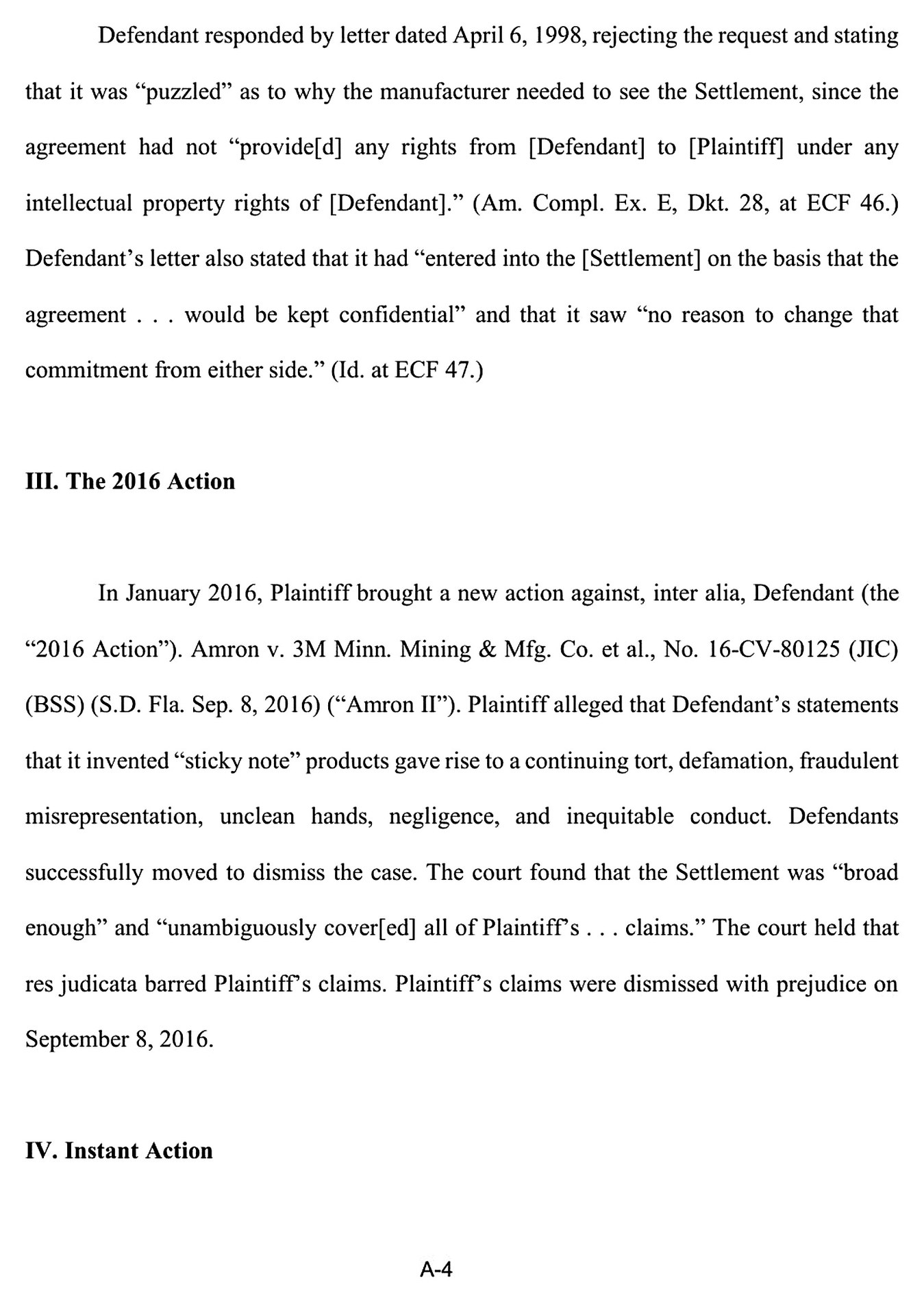
Court appendix page reciting 3M's letter of April 6, 1998
The same letter as the courts have it: the publicly filed appendix in Amron v. 3M Company, No. 26-5031 (U.S.).

The people who made it

An invention is one person. A product is not. Between the November 1973 memo and the 1975 invoices there were a chemist, an artist, two lawyers, a printer, an aerosol filler, a mailing house and a sales rep group. Most of them are named in the papers above. Here they are in order, with the source for each one marked, because on a page that asks you to check the documents you are entitled to know which document you are checking.

Everything below comes from what I swore to in 1997 or from a business paper made in 1974 or 1975. None of it comes from what I remember now.

Two documents means the name appears in two separate records, years apart, neither made to support the other. One document means one contemporaneous paper carries it. Sworn means it comes from the affidavit. Federal record appears once, on Rite-Off, and is explained where it sits.

Dr. David W. Young — chemical consultant, Chicago

One document He answered on November 29, 1973, referring to a memo I had sent roughly two weeks earlier with figures, calling it my invention, and quoting $750 to develop a composition for it. He is the earliest outside name in the record. Document 1 →

Charles Marks — patent attorney, 286 Fifth Avenue, New York

One document The handwritten letter of July 22, 1974 goes to him, encloses samples, and asks him to file for patent protection. My 1997 affidavit adds what he told me: have an artist do renderings and write a description. Document 2 →

Steve Grossman — graphic artist

One document He rendered the concept and then the mechanicals. The drawing survives and carries no date on its face. My 1997 filing dates his work to on or about February 1974; that is the sworn date and the one I rely on. Document 7 →

Rite-Off Corp. — 163 Dupont Street, Plainview, New York

Federal record My chemist in Chicago sent the formula to Rite-Off in Plainview, Long Island. Rite-Off made the first samples for me and then became my supplier: filling the aerosol cans, labeling them, and boxing them for shipment. That is where Stick-Em-Up was made, and Stick-Em-Up is what put the adhesive on the Press-on Memo sheets.

I went and found that company again in the public federal record, and every external fact holds:

  • Rite-Off Corp., 163 Dupont Street, Plainview, New York 11803 — named at that exact street address in the Federal Register in September 1974.
  • Operating there in the window that matters: an EPA enforcement record states that products were held for distribution or sale on March 6, 1974, at Rite-Off Corp., Plainview, New York. Goods on the floor, that spring.
  • An aerosol house, which is what I said it was — EPA file number 9852, covering RITE-OFF DAIRY AND INDUSTRIAL AEROSOL and a line of aerosol sprays.

The company, the street, the business and the year, all confirmed by government records that nobody arranged and nobody can revise. The Stick-Em-Up label they filled and boxed is in Document 12 →

Dave Warren and Kroma Lithographers — 30 West 21st Street, New York

Two documents My 1997 affidavit says I contracted Dave Warren of Kroma Lithographers in April 1974 to print the Press-on Memo sheets, the flyers and the envelopes. One of the 1975 invoices in the twenty-invoice run — No. 5153 — is made out to Kroma at 30 West 21st Street for four cases of the adhesive.

The invoice shows Kroma buying spray from me, not printing for me. What it does is carry the name and the New York address of the printer I would later name under oath — on a business paper written in 1975 for its own reasons, twenty-two years before the affidavit. Document 15 →

Fritz & Solomon, and Michael Solomon — Freeport, New York

Two documents The firm filed the certificate of incorporation for Press On Memo Ltd. on July 24, 1974. Michael Solomon swore to it in 1997: the incorporation, the corporate purpose, and that I was the sole shareholder. Document 4 → Document 6 →

Sol Rebach, Dick Freudenheim, and Mass Mailings — New York

Sworn My 1997 affidavit names the mailing house: Mass Mailings, New York City, contracted in June 1974. It names Sol Rebach, who told me his stationery list held between roughly 1,900 and 2,000 top-level people in the trade — executives, manufacturers, chains and distributors. It also names Dick Freudenheim in connection with the same mailing.

The envelope that went out and the sales sheet that went with it are here: Document 8 → Document 9 →

Arkay Sales, Inc., and Ronald Katz — stationery representatives

Two documents Jeffrey Brown's 1997 affidavit names Arkay Sales as the rep group we joined to sell into the stationery trade, and names Ronald Katz as its president. Invoice No. 5155, dated March 17, 1975, is annotated across it by hand: Delivered By ARKAY SALES 3/17/75. The salesman box on another invoice in the same run reads RK.

Nobody typed that annotation in 1975 to help me in 1997. Document 17 → Document 15 →

Bernard Lane — Exhibition Management Inc., Ridgewood, New Jersey

One document President of the company that produced the National Mail Order Merchandise Show. His February 11, 1975 letter holds booth #85 for Press-on Memo Ltd. and addresses the company at 26 Middle Neck Road, Great Neck — not the Rockville Centre box, which means we had moved by 1975. Document 16 →

The $1.19 offer

Sworn My 1997 affidavit states the asking price: about $1.19 for three fifty-sheet pads, small quantities immediately, larger quantities in three to four weeks. The sales sheet carries the offer. The pads were made, sprayed, printed, mailed, and offered to the stationery trade at a price, with delivery terms, by a New York corporation formed to sell them. Document 9 →

The chain

Young → Marks → Grossman → Rite-Off → Warren and Kroma → roughly 2,000 sheets sprayed and printed → Fritz & Solomon and Press On Memo Ltd. → Rebach and Mass Mailings → the stationery trade → Arkay Sales → the 1975 show floor.

Eleven names. Nine of them are on paper in the documents above, two of them are on my oath, and the markers tell you which is which. That is how a November 1973 memo became a product you could order for $1.19 — and every step of it is here to be taken apart.
Three documents from 3M’s side

Document 21

September 25, 1974 — the date on 3M's own trademark

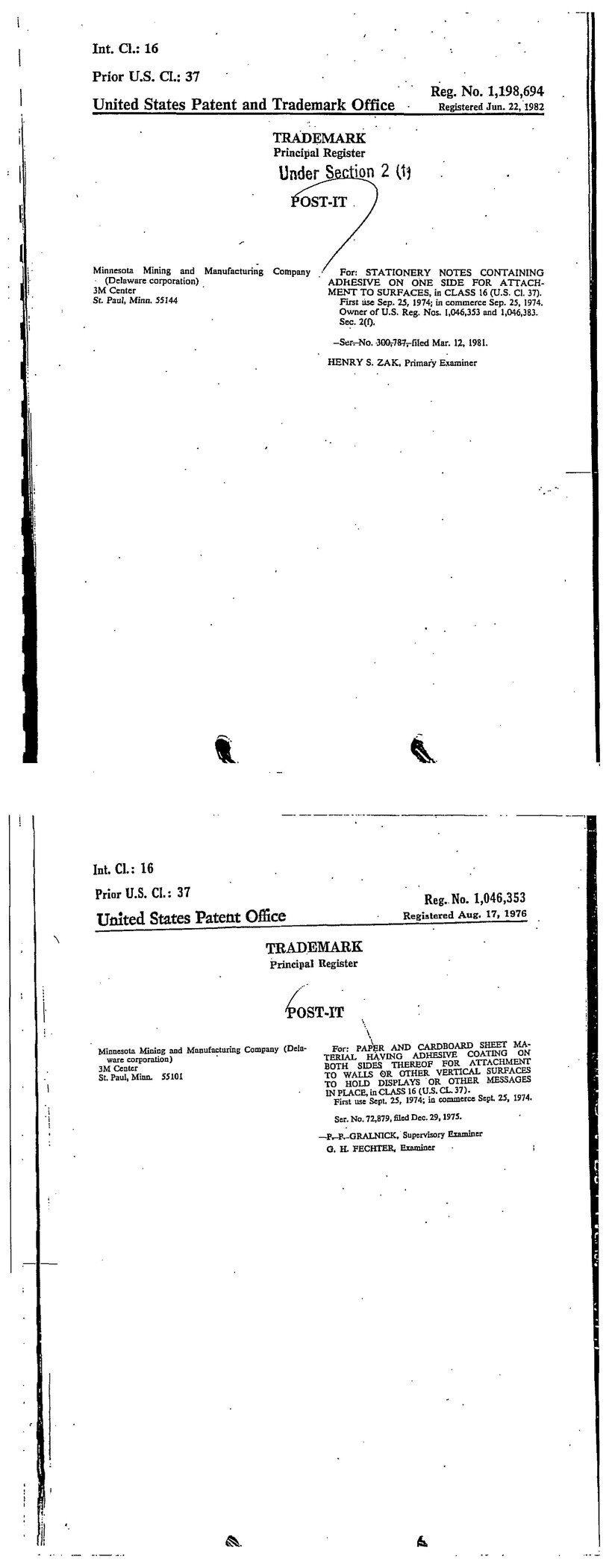
Every document above this one is from my side of the story. These two are from 3M's, and they are certificates issued by the United States Patent and Trademark Office. Anyone can pull them.

Registration No. 1,198,694 covers the Post-it mark for stationery notes containing adhesive on one side for attachment to surfaces. That is the sticky note, described by 3M in its own application. That application was filed March 12, 1981 and the mark registered June 22, 1982. The first use claimed on its face is September 25, 1974, and in commerce September 25, 1974.

My mailing went out on and around July 22, 1974. The date 3M's own registration claims is two months and three days later.

The second certificate is Registration No. 1,046,353, filed December 29, 1975, for paper and cardboard sheet material having adhesive coating on both sides thereof, for attaching displays to walls. A different product entirely — double-sided mounting material. It claims the same first use date: September 25, 1974.

And there is a third thing on the face of the '694 certificate worth noticing. By 3M's own public account, the note pads were not test-marketed until 1977 as Press 'n Peel and not launched nationally until 1980. The date on the registration is three years earlier than the test market.

Both certificates were issued by the United States Patent and Trademark Office and both are public. Anyone can pull them and read the first-use date on the face.

U.S. trademark registrations 1,198,694 and 1,046,353 for the Post-it mark
Filed as Exhibits #20 and #21 in Amron v. 3M, CV-97-7281 (E.D.N.Y.). Both certificates are public at the USPTO.
Document 22

February 10, 2016 — TransWeb, LLC v. 3M

This one is not about me at all, which is exactly why it belongs here.

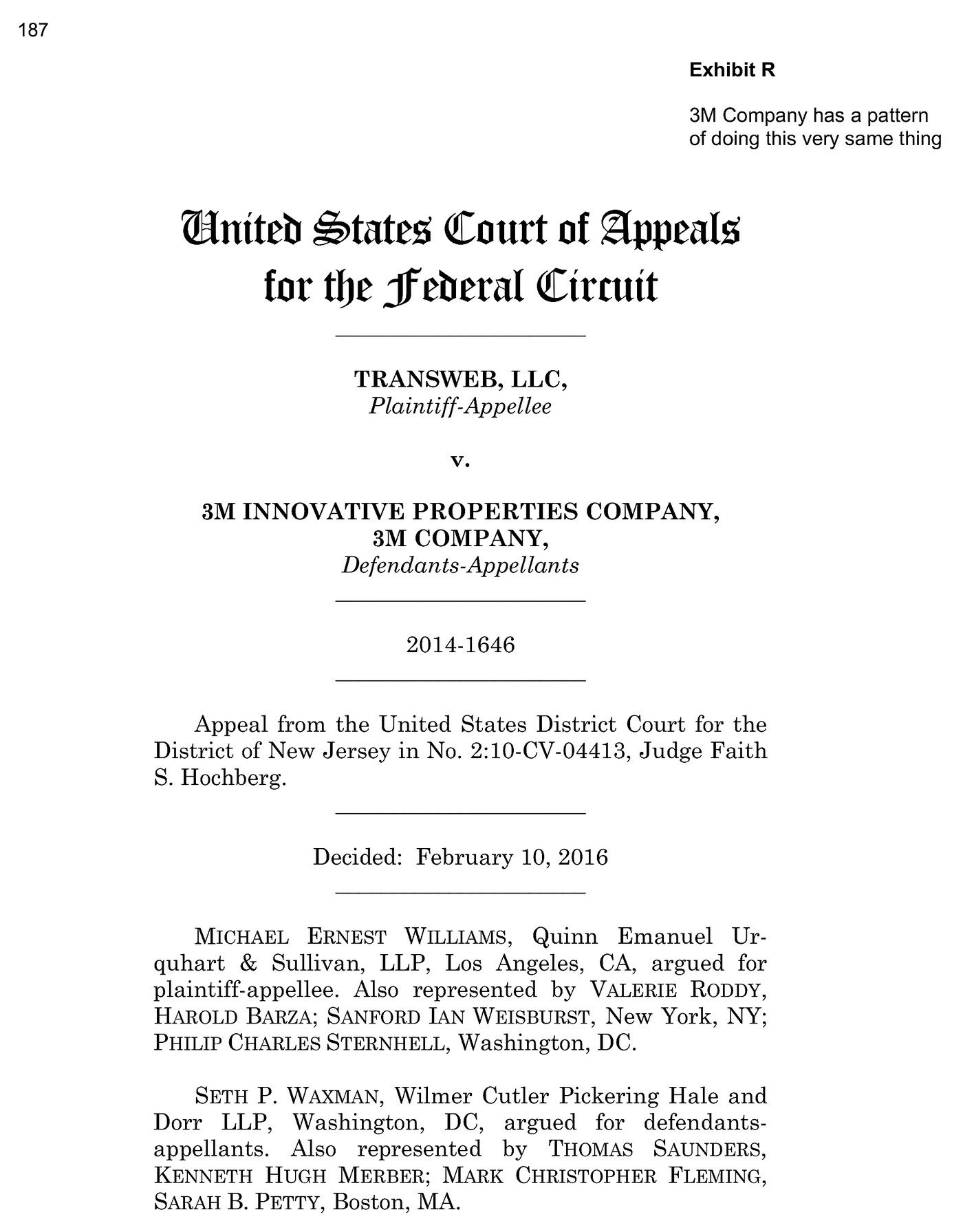
In TransWeb, LLC v. 3M Innovative Properties Company, the United States Court of Appeals for the Federal Circuit affirmed that 3M had obtained a patent through inequitable conduct and was liable under the antitrust laws for enforcing it. The award against 3M came to roughly $26 million, including about $23 million in trebled attorneys' fees.

The conduct the court described: TransWeb's president had handed out samples of his new filter material at a trade show more than a year before 3M filed its applications. 3M told the Patent Office those samples had been received under a confidentiality agreement and were therefore not prior art. The court found that characterization false.

Samples handed out at a trade show, and a confidentiality agreement asserted over them that the court found was not there. That is a published federal appellate decision, decided sixteen days after I filed my own case in 2016 and added to it by amended complaint, and it is a matter of public record.

A published decision of the United States Court of Appeals for the Federal Circuit, decided February 10, 2016, and filed in my own case as Exhibit R.

Federal Circuit decision in TransWeb LLC v. 3M Innovative Properties Company, February 10, 2016
Filed as Exhibit R in Amron v. 3M Minnesota Mining & Manufacturing Company, No. 16-80125 (S.D. Fla.). Federal Circuit No. 2014-1646.
Document 23

1972–1993 — What 3M actually patented

Almost everyone assumes 3M patented the sticky note. Three patents are usually named for it. Pull them and read what each one claims.

U.S. Patent 3,691,140, issued September 12, 1972 to Spencer Silver. Tacky acrylate copolymer microspheres. It is a chemistry patent. It claims an adhesive.

U.S. Patent 4,166,152, “Tacky polymeric microspheres,” application serial 825,259 filed August 17, 1977 by William A. Baker and others, issued August 28, 1979. Another way of making the same class of microspheres. I filed this one myself, as Exhibit #2 in my 1997 case. It is also an adhesive.

U.S. Patent 5,194,299, “Repositionable pressure-sensitive adhesive sheet material,” sole inventor Arthur L. Fry, assigned to Minnesota Mining and Manufacturing. Application 06/948,095, filed December 31, 1986 as a division and continuation-in-part of an application filed October 19, 1984. Granted March 16, 1993.

That is Art Fry's own patent, and it is worth reading the claims. All five are methods of spraying a conventional pressure-sensitive adhesive onto a paper backing so that it dries in a non-repetitive pattern of tiny islands, covering between ten and eighty-five percent of the coated strip. It is a way to manufacture a repositionable sheet without using Silver's microspheres. It is a coating process.

Read all three together and the same thing is missing from each. None of them claims the product: a memo sheet with a repositionable, reusable adhesive on the back, so a note can be written, posted, lifted and posted again. Silver claims a chemistry. Baker claims a chemistry. Fry claims a way of spraying it on paper — and he filed that ten years after 1974 and was granted it nineteen years after.

And in January 1998, in Clause 6, 3M acknowledged in writing that it had no right to prevent me from manufacturing and selling my Press-on memo pads as originally conceived in 1974. That is Document 19.

These three are public and unmediated — no scan of mine stands between you and them. Read them at the source:
U.S. 3,691,140 (Silver, 1972)  ·  U.S. 4,166,152 (Baker et al., 1979)  ·  U.S. 5,194,299 (Fry, 1993)

The 1974 samples — my sworn account

There is one event in this story that matters more than any other, and it rests on my sworn testimony rather than on paper. I am going to put it here, by itself, under its own heading, rather than slide it in among the exhibits.

In 1974 I took a booth at an inventors' exhibition at the Americana Hotel on Seventh Avenue in New York. I was showing three things: the Press-on Memo, the Stick-Em-Up spray I used to make it, and a battery-operated water gun. A man came to the booth and said he was from 3M. He asked how the memo worked and how the adhesive worked. He asked for samples. I gave him samples of both, and he said he would take them back to his boss.

No one ever came back.

That is my account. It is the account I gave under oath in federal court in 1997, and it has not changed.

Records from 1974 keep surfacing. Rite-Off Corp. of Plainview turned up in the federal register half a century later, exactly where I said it was. Trade-show exhibitor lists, hotel records, 3M travel and expense files and industry press from that autumn all still exist somewhere. If a document for this day comes out of one of them, it goes on this page the moment I have it.

I put it here in the open, under its own heading, because the alternative is to bury it in a caption and hope you do not notice. Everything else on this page you can check. This one you weigh.

The two positions

What I claim

Let me be precise about what is mine and what is not. Spencer Silver's pressure-sensitive microsphere adhesive is his, and the Post-it name is 3M's trademark. Neither is what I am claiming.

My claim is the sticky note itself — a memo sheet with a repositionable, reusable adhesive on the back, so the note goes where the message belongs and comes away clean. The documents on this page establish that it existed in written form no later than November 14, 1973, and that it was in commerce in 1974, three years before 3M introduced Press 'n Peel in 1977. That samples went to 3M in 1974 is my sworn account, given under oath in federal court in 1997 and set out above under its own heading.

3M's position

Silver developed the adhesive first, and Art Fry independently found the application for it in 1974 through his hymnal bookmark.

3M disputes all of this and says Post-it Notes owe nothing to my work. Its spokeswoman has said so publicly and by name. Their position belongs on this page too, in their words rather than mine, and you can set it against the documents above.

Where this stands now

The 1997 case settled in January 1998, within weeks of filing, and I agreed to dismiss it with prejudice. No judge decided who invented the sticky note. I want that on my own website, in my own words, because it is true and you would find it out anyway. I did not settle for the money. I settled for Clause 6, and eight weeks later, when I needed to show it to a prospective licensee, 3M refused consent to disclose the agreement.

What happened next is the part still being litigated. In January 2024, 3M asserted against me in federal court that the 1998 confidentiality provision imposed no obligation on 3M. Before that filing, 3M had never asserted that construction against me.

My suit over that conduct was dismissed on claim preclusion — the rule that you cannot bring a claim you could have brought in an earlier case. The Second Circuit denied leave to proceed in forma pauperis and dismissed the appeal on March 20, 2026 under 28 U.S.C. § 1915(e), without reaching the merits of the claim. On March 30, 2026 it denied reconsideration and denied leave to file an amended motion. On April 21, 2026 I petitioned the Supreme Court of the United States. The petition was docketed July 7, 2026 as Amron v. 3M Company, No. 26-5031.

The petition does not ask the Court to decide who invented the sticky note. It asks a narrower question, and one that reaches far past me: whether claim preclusion can bar a claim based on conduct that had not yet occurred when the earlier litigation took place.

No litigant can be required to challenge conduct before that conduct exists. The decision below effectively imposes that requirement — on settlement agreements, licensing and confidentiality agreements, employment contracts, consent decrees, and every other legal relationship that keeps running long after the case that produced it is closed.

↑ TOP